
Choosing the right school curriculum is one of the most important decisions for parents. It establishes the foundation for the cognitive and developmental processes of children.
The ICSE curriculum is one of the most trusted options in India due to its ability to effectively balance academics and creativity. As per the official figures, ICSE has more than 2,750 affiliated schools. Its wide acceptance reflects both credibility and quality.
But what is ICSE curriculum, really? And what makes it so special? Let’s explore its features in detail.
What is the ICSE Curriculum?
The Indian Certificate of Secondary Education (ICSE) is the Class 10 qualification conducted by the Council for the Indian School Certificate Examinations (CISCE). The main specialty of this curriculum is its equal importance of languages, sciences, arts, and skill-based subjects through a three-group structure:
- Group I (Required): English, a second language, history, civics, and geography.
- Group II (Pick 2–3): Math, Science (Physics/Chemistry/Biology), Economics, Business Studies, Environmental Science, Modern/Classical Languages, and so on.
- Group III (Choose anyone): Computer Applications, Economic Applications, Commercial Applications, Art, Performing Arts, Home Science, Physical Education, Yoga, Technical Drawing Applications, etc.
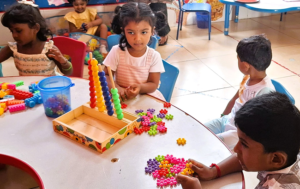
Another advantageous aspect of ICSE is that it is suitable for children of all ages, right from their early age. For instance, the ICSE board LKG syllabus establishes a solid academic foundation by utilising phonetics and numbers.
As students progress to middle and high school, the same curriculum builds on these basics by teaching them more advanced ideas in science, math, and languages.
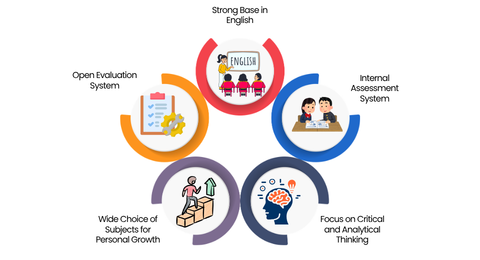
Main Features of the ICSE Curriculum
1. Strong Base in English
English is a compulsory subject in the ICSE curriculum. Additionally, it serves as the primary medium of instruction and evaluation in all ICSE schools.
Thus, students develop good communication and comprehension skills. This provides your child with an advantage, particularly in the context of pursuing higher education abroad.
2. Internal Assessment System
This provides your child with an advantage, particularly in the context of pursuing higher education abroad. Projects, practicals, and laboratory work comprise a substantial portion of the evaluation.
For example, many ICSE board schools in Madurai assign students geography field tasks and research assignments. An evaluation of these constitutes approximately 20% to 50% of the grade.
3. Focus on Critical and Analytical Thinking
The primary focus of ICSE question papers is on application-oriented problems. For instance, a history question can encourage students to look at the reasons and repercussions of an event beyond merely writing down the dates. This nurtures logical reasoning and real-world problem-solving skills.
4. Wide Choice of Subjects for Personal Growth
A variety of courses, including Performing Arts, Yoga, Technical Drawing, and Computer Applications, are available to students, which are not typically offered at other educational institutions. This selection enables each child to pursue their passions, regardless of whether they are artistic, technical, or athletic.
5. Open Evaluation System
On an ongoing basis, the CISCE distributes comprehensive reports and sample papers that evaluate students’ academic performance. These show how marks are awarded and highlight common mistakes. Thus, ICSE guides teachers on providing fair support to students.
ICSE vs CBSE vs State Boards
| Criteria | ICSE | CBSE | State |
| Assessment Mix | 20% of marks are from internals (projects and practicals) | 50% of questions are competency-based | Pattern changes per state. But most of them focus on memorisation |
| Subject Choices | Wide language choices. Arts, PE, Performing Arts, Application-oriented subjects are encouraged | Broad but more standardised | State-specific priorities and textbooks |
| Recent Pass Rate | 99.09% | 93.7% | Depends on the state |
| Acceptance | Highly recognised by Indian and abroad universities | Accepted across India and preferred for national entrance exams | Limited recognition outside the state |
Why Parents Prefer ICSE Curriculum
The number of families opting for the ICSE curriculum is steadily rising. And it’s not hard to see why:
- Many parents believe that ICSE makes it easier for their children to gain admission in international colleges since the board is well-known worldwide and students develop strong English proficiency.
- Children acquire the ability to communicate effectively through speech and writing, which will prove advantageous during future interviews.
- Internal assessments alleviate the stress of “one final exam deciding everything.” This helps them stay more relaxed and focused.
- Parents appreciate it when their children discover their inherent talents in areas such as art, athletics, computing, and design, rather than limiting themselves to textbooks.
- The ICSE curriculum guides students to be well-rounded, a feature that is highly valued by families who prioritise quality over mere grades.
Conclusion
In summary, ICSE provides a comprehensive educational experience. Yes, it fosters academic excellence; however, it also grants children the autonomy to pursue their interests. Many parents strive to achieve that equilibrium when planning their child’s future.
At Vikaasa School, we implement the ICSE curriculum in classrooms through practical learning methods. Here, education goes beyond books. It fosters the development of children’s character and curiosity in addition to their academic abilities.
If you prefer such a well-rounded learning experience, Vikaasa welcomes you to explore our admissions!