
Key Takeaways
- ICSE students manage 10 to 12 subjects; smart scheduling is essential, not optional.
- A study from PJTSAU, Hyderabad found only 35.7% of students actually set study goals and deadlines.
- Divide subjects into high-weightage and manageable categories and rotate them daily.
- Active recall and timed practice papers improve both speed and memory retention.
- Parents who support without micromanaging see better student outcomes.
- Consistency across the academic year matters far more than last-minute cramming.
Your child comes home after a full school day, sits down to study, and before long it is past 10 PM and half the tasks are still pending. Sound familiar? You are not alone. Across top ICSE schools in Madurai and beyond, parents raise this concern repeatedly. The ICSE board is rigorous and rewarding, but without a structured approach, the sheer volume of work can overwhelm even the most sincere student.
The good news is that time management is a skill, not a talent. It can be learnt, practised, and improved. This guide breaks it all down in practical terms so you, as a parent, can support your child the right way.
What Makes the ICSE Curriculum So Demanding?
Before we talk about solutions, it helps to understand the challenge. The ICSE syllabus covers English, Mathematics, Science, Social Studies, and several additional subjects, often totalling 10 to 12 subjects by Class 9 and 10. Each subject demands consistent attention throughout the year, not just during exam season.
Here is a quick look at how ICSE subject categories typically break down:
| Category | Subjects | Study Priority |
| Compulsory | English, Mathematics, Science, Social Studies | High priority daily |
| Group II (any 2 of 3) | History, Geography, Economics, Computer Science | Alternate days |
| Group III (any 1) | Third Language, Art, Physical Education | Weekly, maintain steady practice |
How to Build a Realistic Study Timetable?
A timetable that looks perfect on paper but collapses within a week is of no use. Here is how to build one that actually holds:
- Map the week first. Note school hours, extracurricular activities, and tuition timings before blocking study slots.
- Identify productive hours. Ask your child whether they focus better in the evening or early morning. Plan heavy subjects around those windows.
- Cap study sessions at 45 to 50 minutes. Short, focused sessions with 10-minute breaks in between outperform three-hour marathon sessions.
- Assign subjects to specific days. Rotating subjects prevents fatigue and ensures every topic receives regular attention across the week.
- Keep Sunday as a review day. Use it to revise the week’s learning, not to introduce new topics.
Many educators have found that only a small number of students set clear goals and deadlines for their study sessions. The majority are studying without direction. A structured timetable with defined daily targets changes that entirely. Learning how to manage time for study begins with planning before opening a single textbook.
Which Study Techniques Actually Save Time?
Working harder and working smarter are two different things. These techniques help students cover more ground in less time:
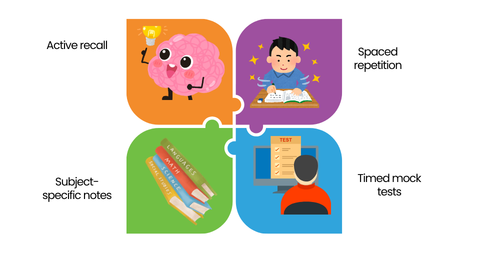
- Active recall: After reading a chapter, close the book and write down what you remember. This strengthens long-term retention far better than re-reading.
- Spaced repetition: Revisit topics at increasing intervals, such as after one day, three days, and then a week. This locks information into memory effectively.
- Timed mock tests: Solving past ICSE papers under exam conditions trains the student to manage time inside the hall. Aim for at least one full timed paper per week in the months leading up to exams.
- Subject-specific notes: Short, handwritten summaries for Science formulae, History dates, and English grammar rules act as rapid-revision tools.
How to Stay Consistent Without Burning Out
Consistency over months is what produces results in ICSE, not one week of intense studying followed by exhaustion. Here is what sustainable preparation looks like:
Students in the best schools in Madurai are often high achievers, and that ambition sometimes creates unnecessary pressure. Teach your child that rest is part of preparation, not a reward for finishing work.
- Maintain 7 to 8 hours of sleep on school nights. Sleep consolidates memory.
- Avoid screen time for at least 30 minutes before bed.
- Encourage physical activity, even a 20-minute walk, three to four times a week.
- Plan one guilt-free hobby or leisure activity per week to prevent resentment of the study routine.
These are not soft suggestions. Research consistently shows that sleep-deprived students retain less, make more errors in calculations, and struggle with reading comprehension. Protect your child’s rest as seriously as their revision schedule.
What Role Can Parents Play in Time Management?
Parents are the single biggest external influence on a student’s study habits. Here is how to help without hovering:
| What Helps | What Hurts |
| Helping set up the weekly timetable together | Checking every hour if studying is happening |
| Ensuring a quiet, clutter-free study space | Comparing performance with other students |
| Discussing weekly progress calmly on Sundays | Adding extra classes without discussion |
| Acknowledging effort, not only marks | Reacting harshly to a poor test result |
At Vikaasa School, we regularly guide parents on how to create the right environment at home. If you are exploring schools in KK Nagar Madurai for your child, know that the school-home partnership makes all the difference to academic outcomes.
Following these time management tips for students at home reinforces what teachers work on in school, and that consistency is where the real improvement happens.
Frequently Asked Questions (FAQs)
1. What is the ideal number of study hours per day for an ICSE student?
There is no single correct answer, as it depends on the class and student. For Class 9 and 10, three to five focused hours outside school, spread across the day, is a reasonable and sustainable target. Quality of attention matters more than total hours logged.
2. When should an ICSE student start serious exam preparation?
Ideally, structured preparation begins from the very start of the academic year. Leaving it to the final three months puts students under unnecessary pressure. Consistent weekly revision throughout the year is far more effective than a last-minute rush.
3. Why does my child study for hours but still underperform?
Long study sessions without clear goals, active recall, or regular breaks often produce diminishing returns. Switching to shorter, goal-specific sessions with variety across subjects typically leads to better retention and test performance.
4. How can I tell if my child’s timetable is working?
Look for signs such as syllabus coverage keeping pace with the school calendar, improved performance in unit tests, and your child approaching exams with calm rather than panic. Review the timetable together once a month and adjust based on what is and is not working.
5. Are study apps and digital planners helpful for ICSE students?
They can be, provided screen use is disciplined. A simple handwritten planner works just as well for many students. The tool matters less than the habit of planning and reviewing daily. If a digital tool reduces planning friction, use it, but monitor that it does not become a distraction in itself.