

Key Takeaways
- Neuroplasticity confirms every child’s brain can grow; intelligence is not fixed at birth.
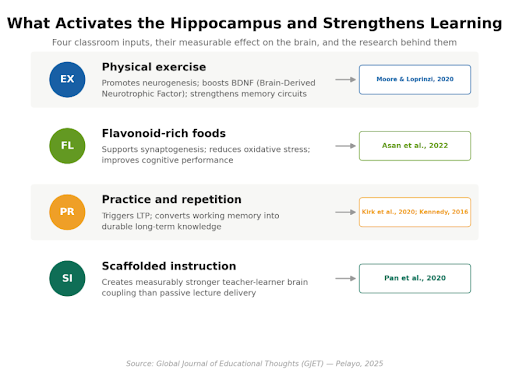
- The hippocampus, the brain’s memory engine, is directly strengthened by exercise, nutrition, repetition, and scaffolded teaching.
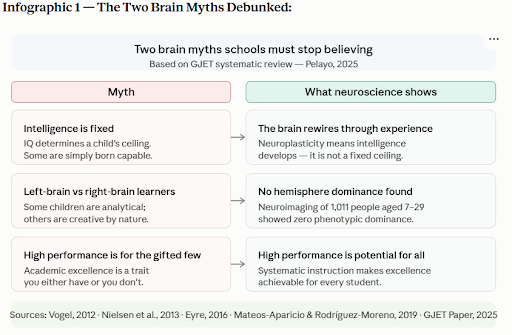
- The left-brain/right-brain learner myth has been scientifically debunked; effective learning requires whole-brain engagement.
- Neuroscience-based learning is a universal approach; high performance is achievable for all students through the right instruction.
- Schools that implement educational neuroscience principles see stronger outcomes across the full ability range, not just for identified high achievers.
What Is the Real Problem with How Schools Understand Intelligence?
Here is a question worth sitting with: how many children have been quietly written off by a system that decided, too early and too confidently, that they were simply “not that kind of learner”?
The belief that intelligence is fixed has shaped classroom practice for over a century. Alfred Binet’s IQ testing in the early 1900s introduced the idea of cognitive ability as a stable, unchangeable trait and that idea has lingered in educational culture ever since. The left-brain/right-brain learner myth compounded this, convincing schools to categorise children before their brains had fully developed.
These are not harmless simplifications. They become invisible ceilings, influencing which students receive challenging material, which get quietly tracked into lower groups, and which are told, implicitly or explicitly, that excellence is not for them.
The problem, put plainly: schools have been operating on neuromyths. Neuroscience and education research is now providing the evidence to replace them. As explored in The Rise of Personalised Learning in Modern Education Systems, the shift away from fixed-ability instruction toward brain-responsive approaches is gaining real momentum.
What Does Neuroscience Actually Show About the Learning Brain?
The foundational finding of educational neuroscience is both simple and transformative: the brain is malleable. Neuroplasticity, the nervous system’s ability to reorganise its structure and connections in response to internal and external stimuli means that every child who walks into a classroom is, by definition, capable of growth.
When students practise a skill repeatedly, the synaptic connections involved strengthen through a process called Long-Term Potentiation (LTP). When they learn something genuinely new, their brains form new connections. This is not a metaphor; it is measurable, structural change. The GJET paper draws on eleven peer-reviewed studies to build this case, creating an evidence base that educators can apply with confidence.
Can Schools Keep Up With the Speed of Technology? explores how schools must evolve their systems, not just their tools, to match what brain science is revealing about how children actually learn.
How Does the Hippocampus Unlock Every Child’s Academic Potential?
The hippocampus is the brain’s primary memory formation centre, responsible for encoding new information, converting short-term experience into long-term memory, and supporting spatial and episodic learning. What educational neuroscience programmes now confirm is that the hippocampus is not fixed. It responds directly to what schools provide.
According to the Annual Status of Education Report (ASER) 2024 by Pratham, foundational learning gaps persist across significant proportions of Indian school-aged children; a challenge that neuroscience-based learning is specifically designed to address by building capacity from where each child’s brain currently is.
The Rise of India’s Education Sector: Key Growth Drivers to Watch contextualises why brain development in early childhood is increasingly central to India’s national education agenda.
What Outcomes Do Schools Achieve When They Apply Neuroscience-Based Learning?
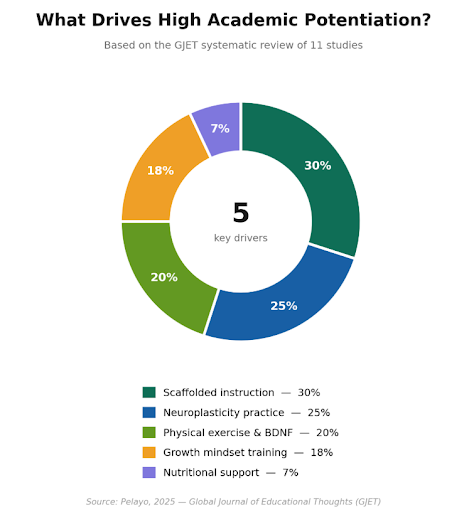
When educational neuroscience principles are embedded in school practice, the outcomes are both measurable and wide-ranging.
TABLE: Neuroscience Outcomes by Approach
| TEACHING APPROACH | OUTCOME |
| Growth mindset instruction | Changes connectivity in dorsal ACC and striatum; builds cognitive resilience |
| Scaffolded questioning over lecture | Stronger brain-to-brain coupling; deeper encoding |
| Varied, whole-brain learning activities | More students thrive; reduces cognitive exclusion |
| Systematic instruction across all abilities | High performance achievable for all, not just the “gifted” |
| Physical activity in the school day | Improved spatial learning, memory, and executive function |
10 Ways of Innovative Teaching Methods That Actually Improve Learning Outcomes shows how these principles translate into classroom strategies that consistently deliver measurable results.
How Can Schools Turn These Findings Into Classroom Practice?
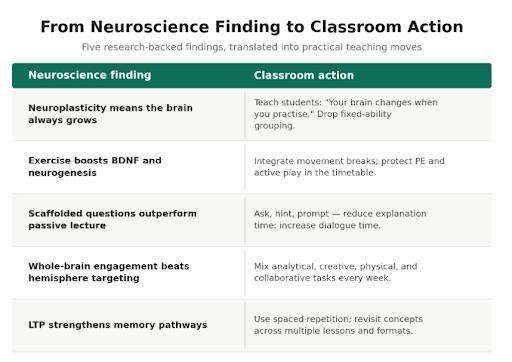
Translating educational neuroscience into classroom practice does not require wholesale reform. It requires a shift in pedagogy.
Preparing for Tomorrow: Technology Integration in Education Today demonstrates how digital tools, when used with pedagogical intentionality, amplify these neuroscience-aligned practices further.
Which GSG Schools Are Already Delivering These Outcomes?
Global Schools Group’s network of 64 campuses across 11 countries operates on a shared commitment to research-informed, holistic education; a commitment directly aligned with the findings of papers like this GJET study.
| GSG SCHOOL | LOCATION | CURRICULUM | NEUROSCIENCE-ALIGNED FEATURE |
| Vikaasa School | Madurai, India | ICSE, Cambridge IGCSE | Experiential learning, early childhood brain-compatible programmes; ideal for families exploring ICSE schools in Madurai, IGCSE schools in Madurai, or playschool admission |
| One World International School (OWIS) | Singapore, India, Japan | IB PYP, MYP | Inquiry-based, whole-brain collaborative learning throughout |
| Emirates American School | UAE | American + IB | Home institution of GJET author; active High Performance Learning implementation |
| Global Indian International School (GIIS) | India, Singapore, Malaysia | CBSE, Cambridge, IB | 600+ international awards; individual academic potentiation embedded in pedagogy |
| Dwight School Seoul | South Korea | IB | Spark programme: personalised learning rooted in individual cognitive strengths |
Together, these schools demonstrate how research-backed approaches can move beyond theory and translate into meaningful learning experiences, stronger student engagement, and well-rounded development. As education continues to evolve, the ability to combine academic excellence with a deeper understanding of how children learn will remain central to preparing students for the future.
Explore Inside GSG’s 600+ Awards: What “World’s Most Awarded Network of Schools” Actually Means to see how these neuroscience-aligned approaches translate into recognised outcomes across the GSG network.
Ready to explore the right learning environment for your child? Enquire Now!
FAQs
1. What is neuroscience-based learning and how does it differ from traditional teaching?
Neuroscience-based learning designs pedagogy around how the brain actually forms and retains memories using scaffolded questioning, physical activity, growth mindset instruction, and varied learning pathways. Traditional teaching often relies on passive instruction and fixed-ability assumptions that neuroscience has now disproven. The practical difference is significant: one approach builds neural capacity; the other assumes it is already determined.
2. Can all children genuinely achieve high academic performance?
The GJET paper’s answer is clear: yes. High performance learning is potential for all, not a privilege of the few. The brain’s neuroplasticity means intelligence develops in response to experience, environment, and instruction — not birth. The question is whether the school is actively creating the conditions that allow every child’s brain to grow. Learn more at GSG’s Awards & Achievements to see how these principles deliver outcomes across the network.
3. How does physical exercise support brain development in early childhood?
Physical exercise promotes neurogenesis, increases BDNF production, and strengthens hippocampal memory circuits (Moore & Loprinzi, 2020). Active play is not peripheral to brain development in early childhood; it is structurally essential to it. Schools that protect physical education and movement breaks are making a measurable investment in every child’s cognitive capacity.
4. What should parents look for in a school applying educational neuroscience principles?
Look for schools that avoid rigid ability tracking, integrate physical activity into the timetable, use scaffolding over lecture, explicitly teach growth mindset, and offer varied cognitive activities. Families exploring the best schools in Madurai will find that Vikaasa School and the broader GSG network are built around exactly these principles. Explore GSG’s full curriculum offering to see how this translates across boards and year groups.
5. How does the left-brain/right-brain myth affect students?
It narrows instruction to match an imagined cognitive preference restricting the variety of experiences that actually support whole-brain development. Nielsen et al. (2013) found no phenotypic hemisphere dominance in over 1,000 individuals. Schools still teaching to hemisphere labels are inadvertently limiting, not enhancing, their students’ neural development.
6. Which GSG schools offer the most advanced neuroscience-informed environments?
- Vikaasa School, Madurai: ICSE and Cambridge; strong early childhood programmes; ideal for playschool admission or families looking for ICSE schools in Madurai
- Emirates American School, UAE: home of the GJET paper’s author; active HPL implementation
- OWIS, Singapore: IB inquiry-based, whole-brain learning throughout
- GIIS, multi-campus: 600+ awards; individual potentiation embedded school-wide Explore all GSG school locations to find your nearest campus.