
As parents explore preschool options in Madurai, you’ve probably heard terms like “play-based learning,” “Montessori Method,” or “experiential education.”
But what do these learning styles mean for your child’s day-to-day experience? And more importantly, which teaching style do preschools in Madurai use?
Understanding different teaching styles helps you find the right preschool that fits your child’s unique learning style. Let’s decode the teaching methods and strategies shaping early education in Madurai and help you make an informed choice.
What are Teaching Styles in Preschool Education?
Different approaches, techniques, or strategies that educators employ to support the learning and development of young minds are known as teaching styles.
Consider them as distinct learning languages; some kids learn best through hands-on activities, while others do best with regimented schedules.
Children between the ages of two and six learn best through, according to early childhood experts:
- Play and investigation
- Social Communication
- Safety of Emotions
- Experiences with the Senses
1. Play-Based and Activity-Based Learning
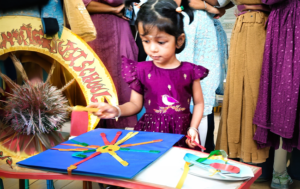
One of the most popular teaching styles in Madurai’s preschool is play-based learning. It combines free play with guided, structured activities, builds language through pretend play, and helps children grasp scientific concepts by mixing colours or playing with water.
It helps children with:
- Children actively participate and explore the environment to build knowledge rather than passively receiving information.
- They develop multiple skills, including fine motor skills, gross motor skills, and emotional regulation.
- It strengthens memory, attention span, and critical thinking.
- Makes learning an enjoyable, natural process, strengthening the desire to learn.
2. Child-Centred and Experiential Teaching Methods
Another popular teaching methodology is child-centred learning, in which the child’s interests, pace, and personality guide classroom activities. Instead of making every child do the same worksheet the same way, teachers observe children’s interests and design experiences around them.
It helps children with:
- Improve retention to help them remember concepts more effectively when they learn through experience.
- Active participation increases motivation and investment in learning.
- It nurtures emotional intelligence, empathy, and interpersonal skills.
- It also fosters independence and a sense of accomplishment.
3. Inquiry-Based and Activity-Driven Methods
Inquiry-based teaching methods, in which kids are encouraged to pose questions and investigate solutions through supervised activities, are also being adopted by some Madurai preschools.
Instead of just watching, kids actively construct knowledge through experiments, sensory play, and open-ended, hands-on activities.
Teachers act as guides and create an environment where children feel comfortable asking questions, sharing ideas, and making mistakes.
4. Technology-Enhanced Learning: The New Frontier
Technology-based learning enhances the learning experience for young children and provides interactive learning opportunities for children to grasp foundational skills and concepts.
Different technologies like smartboards, interactive activities, and educational apps help children improve problem-solving and logical thinking that makes complex concepts easier for young learners to understand.
5. The Hybrid Approach: Why Madurai Schools are Mixing Methods
Finding the ideal balance between learning and the advancement of digital technology is essential to providing high-quality education.
Hybrid learning offers a flexible model that strikes a balance between social interaction and remote flexibility by combining in-person classroom instruction with online learning.
For young children, it allows for customised learning paths and flexible scheduling. In order to understand concepts at their own pace, children can return to digital materials as often as necessary.
Vikaasa’s Approach to Preschool and Nursery Education
Vikaasa School, located in Madurai employ a holistic and child-centred approach to preschool and nursery education. The methodology is designed to bridge traditional values with globally relevant education.
At Vikaasa, early-year teaching is –
- Strongly experiential and play-based with a focus on interaction, curiosity, and creativity.
- Student-centred, ensuring teachers observe and respond to each child’s pace and personality.
- Designed to build social-emotional skills alongside pre-academics, so children feel confident when they enter formal schooling.
- Educators act as mentors and guides rather than traditional instructors, building confidence and inspiring them.
- The curriculum targets five key areas of development: cognitive, physical, social, emotional, and creative skills.
What Parents Should Look for When Choosing a Teaching Style
It’s important to comprehend a child’s interests and learning style. To increase retention, adapt curricula to their preferred learning styles. Strike a balance between routines, supervised activities, and unstructured play.
A good nursery isn’t disorganised or unduly exam-focused. Ask about the size of the class, the ratio of students to teachers, and the ways in which teachers meet the needs of different students. Different learning styles and speeds are respected by child-centred approaches.
Conclusion
Quality preschools builds strong foundation for students and provide holistic development. Play-based, child-centred, experiential learning fosters a better understanding of early childhood development.
Every teaching methodology has its own strengths and limitations. Make sure to understand your child’s personality, interests, and learning style. Visit preschools you are considering for your child to learn more about their infrastructure, methodologies, and curriculum.
At Vikaasa, one of the best preschools in Madurai, we focus on every child and provide personalised attention to understand their learning style. We blend inquiry-based, play-based, and interactive learning styles to help them grow holistically.
FAQs
1.What is play-based learning in Madurai Preschools?
It’s a child-centric, play-based approach that naturally builds language, motor, memory, and critical thinking skills.
2. How does a child-centric approach benefit preschoolers?
The approach helps to foster holistic development – cognitive, social, emotional, and physical through play-based, flexible, and active learning.
3. Why choose a hybrid teaching approach like Vikaasa’s?
Vikaasa blends teaching styles such as play-based, experiential, inquiry, and tech-enhanced to support holistic student growth.
4. What is the teacher’s role in these styles?
Teachers act as facilitators, guides, or observers who help child support their academic journey, improve engagement, and learning outcomes.