
What is Integrated Learning?
Integrated Learning is an educational approach that encourages learners to connect knowledge across subjects and relate it to their experiences. Instead of treating each discipline as separate, it invites students to link concepts, compare perspectives, and apply insights to real-life contexts.
It is a reflection-based learning process that helps students use their existing knowledge to form new understandings, thereby creating a bridge between prior experiences and future applications.
Within the Cambridge International curriculum, integrated learning facilitates independent thinkers. It prepares learners to analyse issues from multiple viewpoints and explore them through inquiry-based learning.
Many schools offering the IGCSE syllabus in Madurai, including Vikaasa, employ an integrated learning approach within their teaching framework to promote contextual learning.
Approaches to Integrated Learning
Integrated Learning often unfolds through a reflective, step-by-step process that guides learners from observation to understanding:
- Raising Questions: Students begin by identifying problems or themes drawn from real situations. Meaningful yet straightforward questions help them connect daily experiences with interdisciplinary knowledge.
- Inquiry and Exploration: Learners investigate underlying causes, exchange ideas, and relate personal experiences to the topic. Open inquiry builds curiosity and a shared understanding.
- Experimentation and Discovery: Through projects, data collection, and active experimentation, students gain firsthand experience of how theoretical knowledge operates in practice.
- Communication and Reflection: Learners evaluate their findings, interpret data, and share conclusions with peers. They assess what has been learned, refine their reasoning, and arrive at informed solutions.
What are the Benefits of Integrated Learning
The integrative learning process stimulates metacognition, an internal awareness of how one learns. Students begin to recognise what they know, identify gaps in their understanding, and evaluate their growth over time.
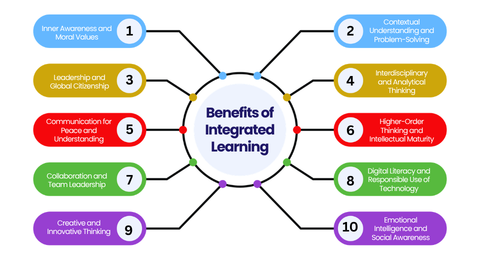
The key benefits of integrated learning are:
1. Inner Awareness and Moral Values
Integrated learning motivates learners to reflect on their thoughts, emotions, and values, gaining a deeper understanding of themselves. They practise empathy, moral judgment, and respect for others, learning to connect personal growth with collective well-being. They also develop sensitivity toward social and environmental issues, remembering to act not only for themselves but also for the common good.
2. Contextual Understanding and Problem-Solving
Learners gain the ability to view problems in relation to their local socio-cultural context. They reflect and investigate to identify real issues within their school or community and find sustainable solutions.
3. Leadership and Global Citizenship
Because integrated learning teaches students to be self-aware and socially responsible, they develop constructive leadership skills. They understand the importance of taking initiative, collaborating meaningfully, and making ethical decisions that correspond with the vision of a peaceful and sustainable global society.
4. Interdisciplinary and Analytical Thinking
Students learn to integrate ideas from different fields of knowledge and apply them holistically, building interdisciplinary competence that enables them to link theory with practice and approach real-world challenges from multiple perspectives.
5. Communication for Peace and Understanding
Learners acquire the ability to use verbal and non-verbal communication thoughtfully. They practise expressing their views with clarity and empathy while respecting cultural and linguistic diversity. They develop the competency that strengthens social harmony and intercultural collaboration.
6. Higher-Order Thinking and Intellectual Maturity
Integrated learning inspires analysis, synthesis, and critical thinking through creative reasoning and problem-solving. Students learn to question, investigate, and critically evaluate information, developing adaptable, forward-thinking mindsets that help them navigate complex global challenges.
7. Collaboration and Team Leadership
Learners understand how to collaborate effectively, share ideas, and value different perspectives. They practise being both leaders and team members, cultivating respect, participation, and shared responsibility to achieve common goals.
8. Digital Literacy and Responsible Use of Technology
The integration of media and technology within learning enables students to access, understand, and utilise digital tools effectively. They learn to critically evaluate online information, engage in digital collaboration, and utilise technology for educational and social advancement.
9. Creative and Innovative Thinking
Through reflection and experimentation, learners enhance their ability to design new ideas and solutions. They combine imagination with analytical reasoning to create outputs that are useful, meaningful, and original.
10. Emotional Intelligence and Social Awareness
Students gain a stronger understanding of themselves and others. They learn to manage emotions, show empathy, and take responsibility for their actions. It helps them endure social situations with ease and strengthen peaceful coexistence.
Vikaasa’s Role in Integrated Learning Experience
As one of the leading IGCSE schools in Madurai, the institution adopts the Cambridge International curriculum framework, which encourages inquiry, reflection, and collaboration.
Teachers create lessons that cross disciplinary boundaries to help students understand complex real-world issues such as sustainability and global citizenship. Reflection is an essential part of the process, as students assess their own growth, participate in service-learning, and connect classroom learning with community experiences.
Technology, too, plays a vital role. By using digital tools for research, communication, and analysis, learners at Vikaasa engage critically with information and develop ethical digital habits.
The school also ensures that education remains active, relevant, and purpose-driven, where learners think independently, act responsibly, and contribute meaningfully to the world around them.