

Do you know that vocabulary growth in early years directly affects how well a child reads and speaks later? In India, this is more important than ever as English becomes part of everyday life. But many parents still ask, How to improve vocabulary in English for kids without stress or pressure?
The good news is, it can be simple. It doesn’t need tough books or long lessons. What children need is language woven into their everyday life, from home to school. Let’s break it down.
Why English Vocabulary Matters Early
The more words a child hears, the more they understand and speak. In fact, children who read five books every day hear around 1.4 million more words by age five compared to those who do not read too often.
That huge gap matters. It shows up in reading skills, confidence in speaking, and class participation. Especially for students at Montessori schools in Madurai or any early learning centre, word use begins with routine.
So parents must act early. And keep it steady.
Easy Ways to Improve Vocabulary in English for Kids
Small changes bring big results. You don’t need fancy tools. You need time, attention, and habit.
Here are ways that work well.
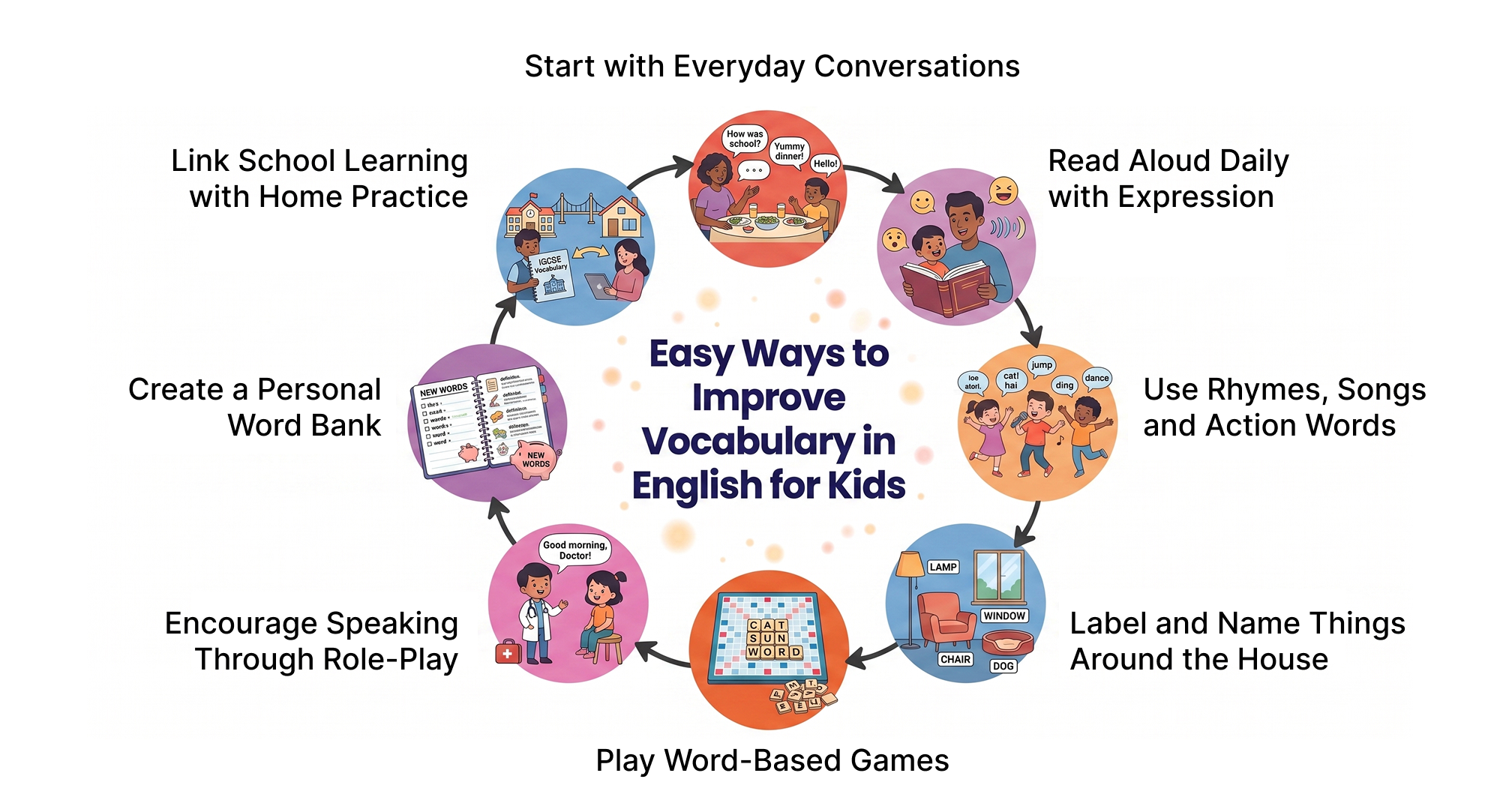
1. Start with Everyday Conversations
Simple talks at home build confidence. Ask your child how their day was. Tell them about yours. Use clear and full sentences. Use new words in small ways. For example:
- “That dress is colourful.”
- “We bought fresh vegetables.”
Correct gently if needed. But mostly, just speak more.
2. Read Aloud Daily with Expression
Reading aloud is one of the best ways to improve vocabulary in English. Choose simple books. Use your voice with feeling. Pause, ask questions.
Let the child guess what happens next. Reading should feel like fun, not study.
And remember, daily reading adds lakhs of words to a child’s ear. It builds strong language memory, especially in the early years.
3. Use Rhymes, Songs and Action Words
Children love rhythm. Rhymes and songs stay in their minds. Use action songs like “Hop like a bunny” or “Touch your toes.” These build verb use.
Repeat often. Encourage your child to lead the song or create their own rhyme. That’s when learning sticks.
4. Label and Name Things Around the House
Labelling common items helps link sight to sound. Use sticky notes or flashcards to name “door”, “chair”, “fan”, “mirror”, and more.
Point and say the word often. Ask the child to find that word. Over time, they’ll start using it in speech.
5. Play Word-Based Games
Games make learning fun. Choose age-appropriate word games that can be done daily.
| Game Type | Activity Idea | Skill Built |
| Spot the Word | Name objects by colour or use | Word grouping |
| I Spy | “I spy something round and red…” | Describing, guessing |
| Picture Match | Match images to written words | Recognition |
| Word Train | Make chains like ‘cat-tap-pot’ | Word recall, thinking |
| Memory Flip | Match pairs of the same word | Visual memory |
Short games like these need no prep and bring quick results.
6. Encourage Speaking Through Role-Play
Pretend play helps your child try new words. Act out shopkeeper, teacher, or doctor roles. Use English during the game.
Let your child switch roles. They will slowly try more words as they feel more confident. And they won’t even know they’re practising.
Even simple props like a cap, an apron, or a toy phone can make role-play more exciting. You don’t need big items. Just use what’s at home. Let your child create scenes, like running a shop or visiting a zoo. As they talk through the story, they try new words. You can join too, but let them lead. This builds both speech and thinking.
7. Create a Personal Word Bank
Give your child a diary or notepad. Every time they learn a new word, write it down. Add pictures or meanings in your language too.
This book becomes their personal dictionary. Let them read from it before bed or on weekends. It’s a small step with a big impact for those asking how to improve English vocabulary and speaking skills.
8. Link School Learning with Home Practice
Match what’s taught at school with home practice. If your child goes to schools in K Pudur Madurai, they likely follow a structured syllabus. Check their notebooks. Ask about topics.
Use that at home to repeat key words. Add a few related words as bonus. For example, if school teaches “water cycle”, you can add “rain”, “cloud”, “steam”, “drop”, and so on.
Children love to show what they know. So when home repeats school repeat, learning feels stronger.
Final Thoughts
Vocabulary doesn’t grow in a day. It grows word by word, story by story, game by game. Let your child hear, speak, read, and play with words every day. It works.
Want a school that supports real-world building from day one? Visit Vikaasa and see how we help parents like you discover how to improve vocabulary in English for your child’s future.