
Key Takeaways
- AI in education personalises learning, automates admin work, and gives real-time feedback
- India’s push is driven by NEP 2020 mandates, GDP projections, and its young population
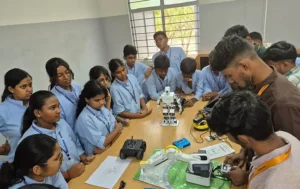
- AI use should scale with age: basic literacy young, coding/research in middle school, STEM/AI-assisted work in secondary
- Good AI tools explain reasoning and build critical thinking, not just give answers
- Key risks: over-reliance, data privacy, bias, and screen-time balance
- AI should support teachers and students, not replace either
Remember when “computer class” meant learning Ms Paint? Yeah, the world has moved on a lot from that. Today kids are growing alongside the boom of AI tools that perform all major tasks including write, draw, code and even teach. So parents should not be second-guessing if their children should learn AI but how do they learn it right. Let’s break it down.
What Are the Real Artificial Intelligence Benefits in Education?
Let’s first take a dive into the good aspects of AI and how it works in making our life efficient:
- Personalised Learning: AI allows students to adapt to study materials at the level that is comprehensible to them. This means each student can learn at their own pace, giving them a better grasp on the study material at hand.
- Administrative efficiency: AI also helps by automating a lot of the administrative tasks that were previously labour-driven. This takes a lot off from the plates of teachers who can spend more time educating the students instead of bureaucracy.
- Accessibility: AI provides students with high-quality educational resources irrespective of their economic status or where they are based at.
- Continuous Assessment: AI can promptly improve a student’s progress and provide immediate feedback. This helps the students assess their strengths and shortcomings and work accordingly.
Why Does India Need to Prepare Students for AI Now?
The boom of AI in the work sector makes having knowledge and learning with AI a call for the hour for students. This is further back by government numbers that state:
- Experts project AI will add trillions to the national GDP by 2047. Students need skills in machine learning and data science to secure these high-paying jobs.
- The government’s National Education Policy (NEP) 2020 requires AI and coding in schools. The Union Budget allocated ₹500 crore to build an AI education center.
- More than 65% of India is under age 35. Preparing students creates a massive “youth dividend“. It turns India from an AI user into an AI creator.
The job market is shifting and it is shifting fast. Under such circumstances, the students should be brought up to pace with the recent trends so that their chances of a bright future does not get compromised.
How Does Learning With AI Actually Work in Schools?
As much as AI seems efficient it is important to remember that it is here to help us, not do our entire job for us. So the ethical implications of AI is important so that it helps in gaining productivity
| Age Group | How Learning with AI Typically Looks |
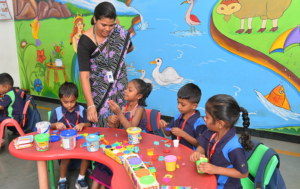
| Primary (6-10 yrs) | Interactive apps, adaptive quizzes, gentle intro to digital literacy |
| Middle School (11-14 yrs | Research projects using AI tools, basic coding, critical evaluation of sources |
| Secondary (14+ yrs) | STEM labs, AI-assisted research, real-world problem-solving projects |
What Should Artificial Intelligence for Students Actually Look Like?
AI must perform more than simply answering queries or completing homework; it should act as an educational ally in helping students comprehend concepts, stimulating excitement, and develop independent learning ability rather than being a substitute for teachers in the process of becoming aware of the subject matter.
An ideal learning with AI experience should include:
- Personalised learning that adapts to each student’s pace, strengths, and areas for improvement.
- Concept-based explanations that help students understand why an answer is correct instead of simply providing it.
- Constructive feedback that identifies learning gaps and suggests ways to improve.
- Support for creativity and critical thinking through open-ended questions, projects, and problem-solving activities.
- Responsible AI usage by teaching students about ethics, digital literacy, and academic integrity.
In the right hands, AI propels students to study fearlessly while teachers get a chance to track students’ performance and progress. The best AI allows learners to study better, rather than simply doing the studying..
Why Do the Ethical Implications of Artificial Intelligence Matter for Kids?
This is the part that worries parents the most and justifiably so:
- Over-reliance: being too overly dependent on AI can snatch away your kid’s ability to think organically. Hence it is important that they use it as a support and research tool instead of turning it into an enabler.
- Data privacy: AI suffers from multiple accusations of data breach. Hence, it is very important to monitor the data shared by the students carefully so that no sensitive data gets shared.
- Bias Awareness: AI tools collect a lot of their data from the information and prompts that are being fed to them and that data isn’t always correct. Hence, at all stages that content received from AI should be factually verified.
- Screen balance: Tech use should never crowd out play, sports, or face-to-face conversation.
A Quick Word on Choosing the Right School in Madurai
If you’re comparing options locally, Vikaasa Schools are worth a look. As one of the well-known top ICSE schools in Madurai, Vikaasa blends ICSE and Cambridge IGCSE pathways with modern computer labs, AV rooms, and a genuine focus on digital literacy alongside critical thinking. Their Jubilee School campus in K. Pudur and Public School campus in KK Nagar make them a convenient option if you’re checking out schools in K Pudur Madurai or schools in KK Nagar Madurai. Often mentioned among the best schools in Madurai, they’ve built a 55-year academic legacy while keeping pace with where education is actually headed.
FAQs
1. In what ways can schools prepare students for the future with AI?
By combining the teaching of age-appropriate digital literacy, critical thinking, STEM experience, and appropriate teacher support instead of replacing teaching with technology.
2. What advantages does AI offer to teachers and students?
The ability to personalise learning, gain immediate feedback, and gain early access to technologies that will be very important in future jobs.
3. Is the learning process dangerous for young children?
When used under teacher supervision, age-appropriate, and aimed at stimulating curiosity instead of replacing effort, the use of AI is safe.
4. Which ethical dilemmas relating to AI should parents discuss with their children’s schools?
Data security and privacy issues, dependence on AI, and the issue of bias which should be raised with children’s schools.
5. How to prepare kids for using AI without too much pressure?
Start with the basics, let kids feel comfortable with critical thinking, and focus on the technology when they are attending the classes.