

Helen Keller was a polyglot. Not only did she know at least one sign language, but she also learned to read and speak English, French, German, and Latin. For someone who could neither see nor hear, it is an extraordinary achievement – a reminder that learning a new language has no barriers if you put your mind to it, along with persistence, curiosity, and the right approach.
So, what’s stopping you? Let’s figure out a few tips to learn a new language, foreign or otherwise.
1. Conversation Trumps Perfection
So, you are in the ICSE syllabus and contemplating whether to choose French or Sanskrit. Or you are thinking of moving in a new direction – pick up a few words of Spanish for your next trip to Barcelona. The principle remains the same: conversation, conversation, conversation.
If you don’t mumble a few words, even with the wrong meanings, stumble over grammar, and sometimes misspell, you are not in the league to master a new language.
No amount of hacks can replace talking to people. An hour of awkward conversation with a native or fluent speaker beats five hours in a classroom and ten hours with an app.
Language is an evolving, dynamic thing – it lives and breathes through you. It is meant to be processed, used, not memorised. When you talk to someone, you are forced to think on your feet, recall vocabulary, and interpret meaning in real time.
There’s no “I’ll do this when I’m ready” time. It is now or never. Start speaking from day one. Join online communities or chat groups where people exchange tips and encourage you to learn more. Talk aloud to yourself. Speak to your friends, even if they scratch their heads in bewilderment.
The first step will always be a bit awkward, but once you get a hold, climbing the rest becomes easy.
2. Learn Intensively and Continuously
In 2025 alone, around 6000 new words were added to the English language, and 150 to the French dictionary. Isn’t it mind-boggling? How do you learn a language so quickly? The trick is in intensity and consistency.
It is better to study for 4 hours a day for 2 weeks than 1 hour a day for 2 months. Frequent repetition helps transfer new words from short-term to long-term memory. Block out a specific period in your life: watch shows, listen to podcasts, label items at home in your target language, and think in it as much as possible.
Students at Vikaasa, one of the best schools in Madurai, are often encouraged to integrate immersive techniques in their study habits through drama, group discussions, or language games. Consistency beats cramming every single time.
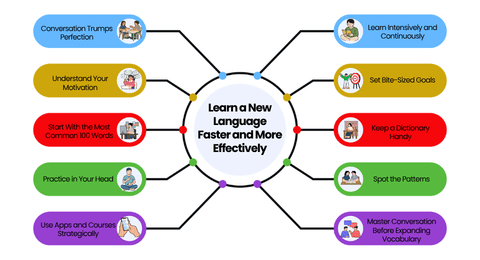
3. Understand Your Motivation
Learning a new language effectively starts with understanding why you want to do it. Are you learning a new language to explore a culture you love? Planning to start a new life in a different country? To communicate while travelling? Or to expand your career options?
You can will yourself through difficult tasks for a short time, but without practical benefits, you will eventually burn out. So, knowing the why gives you clarity and keeps you going even when the grammar feels confusing and the vocabulary endless.
Learners who connect language learning to real-life purposes tend to perform better and retain knowledge longer.
4. Set Bite-Sized Goals
“I want to be fluent in six months” sounds great, but what does fluent mean? Casual conversation? Reading literature?
Instead, set clearly defined goals: “By the end of today, I will know how to introduce myself. In two days, I will learn to ask someone what they do for a living. By week’s end, I will know how to order food.”
Setting one goal at a time will take you furthest on the path to fluency.
5. Start With the Most Common 100 Words
One of the best tips for learning a new language? Start with the 100 most common words; they account for 50% of all spoken communication. These include words like “I,” “you,” “want,” “go,” and “eat.” Learn just enough grammar to construct sentences using it, and practice until you are comfortable.
6. Keep a Dictionary Handy
Download a dictionary app on your phone. Looking up words mid-conversation is quick, and because you are using them in context, you will remember them. Apps like Google Translate, Linguee, or offline dictionaries are simple tools that make a massive difference in your ability to communicate.
7. Practice in Your Head
We all have monologues running in our heads, usually in our native language. Challenge yourself to think in your new language instead. Visualise conversations you are likely to have before you actually have them.
For example, practice how you’d solve a math problem or explain why you are joining the science club in the language you want to master. Internal rehearsal builds fluency subconsciously.
8. Spot the Patterns
Languages in the same family share pronunciation patterns. Words ending in “-tion” in English usually end in “-cion” in Spanish and “-cao” in Portuguese. English speakers joke about adding “-o” to words to make them Spanish, but it works surprisingly often: “destiny” becomes “destino,” “motive” becomes “motivo.”
Spotting these patterns helps you predict meanings and pronunciation.
9. Use Apps and Courses Strategically
Tools like Benny Lewis’ Language Hacking courses, Babbel, Memrise, and Duolingo are great for learning your first 100 words and basic grammar. They can get you speaking simple sentences within days.
But don’t rely on them exclusively. The best return on investment comes from forcing yourself to speak with real people. Apps encourage you to copy patterns, but honest conversations force you to formulate meaning on the spot.
10. Master Conversation Before Expanding Vocabulary
Get comfortable constructing thoughts, jokes, and ideas on the fly. Once you can consistently joke in your new language, that’s a sign you are ready to expand your vocabulary.
The Bottom Line
Learning a language doesn’t require exceptional talent; it just needs the right approach. Talk to people as much as possible, study intensively rather than sporadically, focus on the most useful words first, and keep your motivation clear.
If you are interested in the ICSE syllabus for learning a new language or looking for the best schools in Madurai that offer strong language programs, remember that effective language learning happens both inside and outside the classroom.