
As a parent, you want your child to do well in school. But you also want them to do well in life. And those two things, while connected, are not always the same. That is why problem-solving skills deserve a serious conversation, especially for learners following the IGCSE curriculum.
What Are Problem-Solving Skills, and Why Do They Matter?
Problem-solving skills are the ability to identify a challenge, think through possible solutions, and take action to resolve it. They draw on reasoning, creativity, and decision-making all at once.
For IGCSE learners in particular, these skills are baked into the curriculum. Cambridge assessments regularly test students on applying knowledge to unfamiliar situations, not just recalling facts. So, building this ability early gives your child a real academic advantage.
Why Should Parents Focus on This Now?
The habits your child develops between Grades 6 and 10 tend to stick. When learners at the IGCSE syllabus schools in Madurai are exposed to structured problem-solving from an early age, they carry that mindset into competitive exams, university, and careers.
Think about it: an examiner presenting a data response question or a science case study is testing exactly this; can your child think through something they haven’t seen before?
How to Develop Problem-Solving Skills in Students: Practical Approaches
Here are approaches that actually work, both at school and at home.
| Approach | What It Looks Like at Home | What It Looks Like at School |
| Encourage curiosity | Ask “What do you think?” instead of giving answers | Open-ended classroom discussions |
| Activity-based learning | Board games, puzzles, and building projects | Group projects, lab experiments |
| Real-world application | Involve your child in household decisions | IGCSE case studies and data tasks |
| Reflective thinking | Talk through mistakes without judgment | Peer review and teacher feedback |
Try resisting the urge to immediately solve your child’s problems for them. When they hit a roadblock with homework, a friendship situation, or a decision, pause and ask, “What options do you think you have?” That single habit builds more thinking capacity than any worksheet.
Which Problem-Solving Methods Work Best for IGCSE Learners?
There are several problem-solving methods commonly used in strong academic environments. The most effective ones for IGCSE students include:
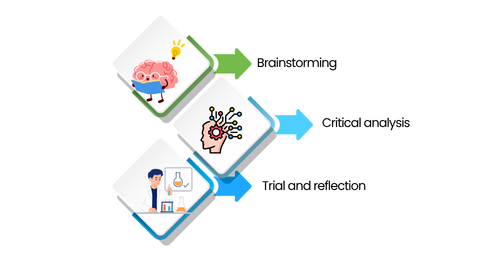
- Brainstorming: Generating multiple ideas without immediately judging them. This helps learners explore the full range of a problem before narrowing it down.
- Critical analysis: Breaking a problem into parts, evaluating evidence, and identifying bias or gaps. This is directly assessed in IGCSE subjects like Global Perspectives and English.
- Trial and reflection: Attempting a solution, observing what happens, and adjusting. Science practicals at the IGCSE level are built entirely around this method.
How to Improve Problem-Solving Skills at Home?
Many parents ask how to improve problem-solving skills without turning the home into a classroom. The answer is simpler than you might expect.
Everyday conversations are powerful. Discussing the news, a film, or even a disagreement in the family gives children practice in forming opinions and thinking through consequences. Asking “why do you think that happened?” or “what would you have done differently?” keeps the brain engaged.
Reading across genres, not just textbooks, also builds the mental flexibility that supports problem-solving. Stories put children in other people’s situations and ask them to make sense of complex emotions and decisions.
How to Improve Problem-Solving Skills in Students: The School’s Role
Teachers and schools play a central role in how to improve problem-solving skills in students. The best schools in KK Nagar, Madurai, do this by designing lessons that ask learners to do things, not just absorb information.
At Vikaasa Schools, our approach to the Cambridge IGCSE curriculum is deliberately learner-centred. Students work through real-world scenarios, collaborate on open-ended tasks, and receive feedback that teaches them to think, not just perform.
Being among the best schools in Madurai means we hold ourselves to that standard every day.
Frequently Asked Questions
1. What is the right age to start building problem-solving skills?
There is no minimum age. Children as young as three begin solving simple problems through play. The earlier families and schools nurture this, the stronger the foundation.
2. How does the IGCSE curriculum support problem-solving?
IGCSE subjects are structured around application and analysis. Papers regularly present unseen scenarios and require students to reason through them, making problem-solving central to academic success.
3. What can I do if my child gives up quickly when faced with a difficult task?
Start with smaller challenges and celebrate the process, not just the outcome. Building a habit of persistence takes time. Praise the effort and the thinking, not only the result.
4. How do I know if my child’s school is developing these skills effectively?
Look for signs that your child can explain their thinking, not just their answers. Talk to teachers about how problem-solving is embedded in everyday lessons, and observe whether your child approaches challenges with curiosity rather than anxiety.