
You know why teachers spend a considerable amount of time helping students think logically? It is because when young kids excel at logical reasoning, their brain activity peaks, triggering chemical reactions, forming neural connections, and developing fine motor skills.
And the long-term impacts are irreplaceable: improved logical thinking leads to better decision-making and problem-solving. To make rational judgements, children need to analyse, evaluate, infer, and reason.
Why Logical Thinking Must Start at an Early Age
Research shows that children who develop strong reasoning abilities early perform better academically across subjects. A study published in Child Development found that early childhood logical reasoning skills predict mathematical achievement years later. When children learn how to improve logical thinking, they build cognitive frameworks that support learning throughout their lives.
Even logical thinking for kindergarten students can begin with simple activities. At this foundational stage, children start recognising patterns, understanding cause and effect, and making basic connections that form the bedrock of analytical thought.
Evidence-Based Strategies to Increase Logical Thinking
1. Puzzle and Pattern Games
Puzzles are exceptional tools for developing reasoning abilities.
According to educational psychologist Dr Susan Levine from the University of Chicago, “Spatial reasoning activities, including puzzles, improve children’s mathematical thinking and problem-solving abilities.”
- Start with age-appropriate jigsaw puzzles, tangrams, or children’s Sudoku variations.
- Pattern recognition games help children predict sequences and understand logical progression.
- Ask your child to complete patterns using blocks, colours, or shapes
Play-based learning naturally strengthens a child’s logical reasoning skills.
2. Strategic Board Games
Chess, checkers, and strategy-based board games require forward thinking and analysis of consequences.
Research from the University of Memphis demonstrated that children who played chess showed significant improvements in mathematical problem-solving and critical thinking.
Board games teach children to think logically by forcing them to consider multiple moves ahead and evaluate different outcomes.
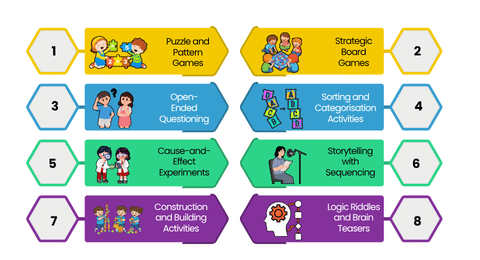
3. Open-Ended Questioning
Instead of yes-or-no questions, ask “why” and “how” questions that prompt deeper thinking. “Why do you think the leaves change colour?” or “How could we solve this problem differently?” Such questions encourage children to articulate their reasoning process, strengthening logical pathways.
Dr Alison Gopnik, developmental psychologist at UC Berkeley, notes that “when children explain their thinking, they consolidate their understanding and develop metacognitive awareness.” Essentially, they learn to think about their thinking.
4. Sorting and Categorisation Activities
Have children sort objects by multiple attributes: colour, size, shape, or function. The activity, recommended by the National Association for the Education of Young Children, develops classification skills essential for logical reasoning. Start simple with toys or household items, then progress to more complex categorisation challenges.
5. Cause-and-Effect Experiments
Simple science experiments beautifully demonstrate logical relationships. What happens when you mix baking soda and vinegar? Why does ice melt faster in warm water? Give children hands-on experiences to form hypotheses, observe outcomes, and draw conclusions, cultivating logical thinking abilities.
6. Storytelling with Sequencing
Ask children to retell stories in order or predict what might happen next. The activity develops sequential thinking and inference skills. Use picture books with a straightforward narrative for storytelling. You can also use story cards for children to arrange in logical order.
7. Construction and Building Activities
LEGO, blocks, and construction toys require spatial reasoning and problem-solving. According to research in Frontiers in Psychology, constructive play enhances executive function skills, including planning and logical reasoning. Children must think ahead about how pieces fit together and troubleshoot when structures don’t work as planned.
8. Logic Riddles and Brain Teasers
Age-appropriate riddles challenge children to think critically and consider multiple perspectives. Start with simple riddles like “What has hands but cannot clap?” Don’t reveal the answer immediately. Prompt them to think. Offer multiple clues and gradually increase complexity.
Research from the Journal of Educational Psychology suggests that regular exposure to puzzles and riddles strengthens deductive reasoning and helps children learn to systematically eliminate incorrect options.
The Role of Quality Education
Educational institutions like Vikaasa recognise that improving logical thinking means creating holistic individuals. Many ICSE schools across India are incorporating critical thinking into their curricula through project-based learning and inquiry-driven instruction.
Institutions following the Cambridge International Primary curriculum particularly emphasise reasoning skills through their structured approach to mathematics and science, ensuring children develop analytical abilities alongside content knowledge.
Conclusion: Making It a Daily Habit
The key to developing logical thinking doesn’t lie in intensive tutoring sessions. It is built through consistent, playful engagement.
Incorporate reasoning activities into daily routines: discuss the logic behind traffic rules during car rides, talk through cooking measurements while preparing meals, or analyse storylines while reading bedtime stories.
Every child develops at their own pace. The goal isn’t perfection but progress. When you create an environment where questioning is encouraged, mistakes become learning opportunities, and thinking becomes second nature.
In the end, it is all about helping your child navigate life’s complexities with confidence and clarity.