
Think back to your own school days. Were you learning to pass an exam, or were you learning to truly understand the world around you? If you are a parent today, that question matters more than ever because the answer shapes the kind of adult your child becomes.
That is precisely where outcome-based education steps in. It shifts the spotlight away from what teachers deliver in the classroom and places it firmly on what students are actually able to do once they walk out. At Vikaasa Schools, we believe that understanding this approach helps parents make better, more informed choices about their child’s education.
What is Outcome-Based Education?
The definition of outcome-based education is straightforward: it is a student-centred approach to teaching and learning where clear, measurable goals are set first, and everything else such as curriculum, teaching methods, and assessments are designed to help students achieve those goals. Rather than treating every child as a passive recipient of information, outcome-based education treats each learner as an active participant who must demonstrate real understanding and skills.
In a traditional classroom, the process tends to follow a fixed syllabus and ends with an examination. In an OBE classroom, educators begin by asking: “By the end of this programme, what should this student be able to think, do, and value?” The teaching then works backwards from that answer.
Why Does This Matter for Students?
India’s education story is one of remarkable access and persistent quality gaps. The country has over 1.47 million schools and more than 250 million enrolled students. Yet quality of learning remains a serious concern. Many studies revealed that average competency scores in foundational subjects decline as students move from Grade 3 to Grade 8, pointing to a system that prioritises coverage over comprehension.
The National Education Policy (NEP) 2020, India’s landmark education reform, directly addresses this by mandating a shift towards competency-based learning and assessment for holistic development. This is fundamentally aligned with OBE-based education principles: defining what students must achieve, and building every classroom experience around that goal.
How Does OBE-Based Education Actually Work in a School?
You might be wondering what this actually looks like for your child on a Monday morning. Here is a simple breakdown:
| Aspect | Traditional Education | OBE-Based Education |
| Focus | Syllabus completion | Student learning outcomes |
| Assessment | End-of-term exams | Continuous, skill-based evaluation |
| Teaching Role | Information delivery | Facilitate, guide, and mentor |
| Measure of Success | Marks scored | Competencies demonstrated |
| Student Role | Passive listener | Active, responsible learner |
In OBE-based education, teachers define Course Outcomes (COs) at the start of each subject. Every lesson, activity, and assessment is then aligned to help students meet those outcomes. Parents can therefore ask very specific questions: “What will my child be able to do by the end of this term?” and expect a concrete, measurable answer.
What Are the Key Benefits for Your Child?
- Clarity of purpose: your child always knows what is expected of them and why.
- Deeper understanding over rote memorisation: skills are practised, not just memorised.
- Better preparation for higher education and careers in a competitive world.
- Greater parental involvement: OBE invites families to be part of the learning conversation.
- Holistic growth: knowledge, skills, and values are all measured and nurtured.
How Does Vikaasa Schools Practise OBE?
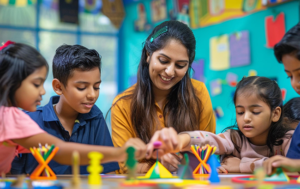
At Vikaasa Schools, outcome-based education is woven into every dimension of school life. Whether in our academic programmes or our co-curricular activities, every learning experience is mapped to clear outcomes that prepare students for the real world.
As one of the best schools in Madurai, we design our curriculum so that assessments tell you exactly where your child stands in terms of actual capability, and teachers work collaboratively to close any learning gaps before they widen.
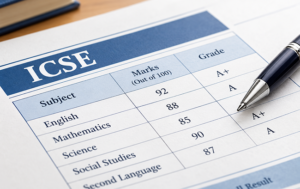
Our school, one of the reputed schools in KK Nagar Madurai, combines the rigour of structured OBE-based education with a warm, child-centred environment. As a proud ICSE school, Vikaasa follows a curriculum that aligns naturally with outcome-based principles: fostering analytical thinking, communication, and problem-solving alongside academic knowledge.
Frequently Asked Questions
1. What is the main difference between OBE and traditional education?
Traditional education focuses on covering a fixed syllabus and measuring performance through standardised exams. Outcome-based education begins with defining what students must be able to do, and then designs all teaching and assessment around achieving those goals.
2. Who benefits most from OBE-based education?
All students benefit, but those who struggle with rote-based learning gain the most. When learning is tied to real-world outcomes rather than memorisation, students with diverse learning styles find greater success.
3. How does OBE affect the way my child is assessed?
Assessments in an OBE framework are continuous and varied — projects, presentations, practicals, and portfolios alongside written tests. They measure what your child can actually do, not just what they can recall.
4. Does NEP 2020 support OBE?
Yes. India’s NEP 2020 explicitly calls for a shift towards competency-based learning and outcome-based assessment. Bodies like NAAC and NBA have been mandating outcome-based education frameworks in accredited institutions since 2013.
5. How can parents support OBE at home?
Ask your child’s teachers what the learning outcomes are for each term. Engage with progress reports that highlight skills and competencies. Encourage your child to reflect on what they have learned rather than what marks they scored.
Conclusion
Education is one of the most important investments a family makes. Understanding what is outcome-based education is the first step towards choosing a school that measures its success not by how much it teaches, but by how much your child genuinely grows. Visit our website to learn more about our approach to learning.