
Key Takeaways
- A preschool assessment is an observation-based tool used to track your child’s growth across language, motor, social, and cognitive areas.
- The importance of assessment lies in helping educators tailor learning to each child’s unique pace and needs.
- There are two primary types of assessments: formal (standardised) and informal (observation-based).
- Research by NCERT (India) shows that early identification of developmental gaps significantly improves learning outcomes by Grade 1.
- Assessments should feel stress-free for children; they are conversations about progress, not tests to pass or fail.
- Parents play an active role, attending progress meetings and understanding assessment results is part of the journey.
What is a Preschool Assessment?
You hand your child over to a teacher on Day 1 of preschool, and somewhere in the back of your mind, a question sits quietly: Is my child learning? Are they keeping up? This is precisely where preschool assessment comes in.
A preschool assessment is a systematic, observation-based process that educators use to understand where a child stands in their development. It looks at how your child communicates, moves, plays, and relates to other children. It is not a test. There are no right or wrong answers. At Vikaasa School, our preschool educators use assessments to see each child as an individual, not just a student in a classroom.
Curious about what a full preschool programme looks like? Read our Preschool Education at Vikaasa.
Why Does Assessment Matter in Early Childhood?
The importance of assessment in preschool cannot be overstated. Children who receive early identification and support for developmental gaps show significantly stronger academic performance by the time they reach Grade 1. Early assessment is the bridge between where a child is and where they need to be.
Here is what regular assessments make possible:
- Personalised learning: Teachers can adjust their approach to match how your child learns best, whether through play, storytelling, or hands-on activity.
- Early identification of support needs: If a child needs additional help with language or motor skills, early intervention has the greatest impact.
- Transparent communication: Assessments give teachers concrete, specific information to share with you during parent meetings rather than vague generalisations.
- Curriculum improvement: Teachers use assessment data to see whether their teaching methods are actually working.
For more on how schools in Madurai keep parents informed about child progress, Also Read: How do schools in Madurai communicate with parents about student progress?.
What are the Types of Preschool Assessments?
Understanding the types of preschool assessments helps you make sense of what your child’s teacher is actually observing. There are two main categories, and most good preschool programmes use both.
| Type | What It Involves | Example |
| Formal | Structured tools, checklists, or standardised benchmarks. Skills are rated as ‘present’, ’emerging’, or ‘not yet seen’. | A teacher uses a checklist to assess whether a child can count to 10, identify colours, and follow two-step instructions. |
| Informal | Ongoing observations during normal classroom activities, play, and conversations. The child is unaware they are being assessed. | A teacher notices that a child can retell a story after circle time, showing strong listening and language comprehension. |
Both approaches are considered valid types of assessments in education, and together, they provide a much fuller picture of your child than any single method could.
To learn more about teaching approaches used at preschools in Madurai, see: What teaching styles are popular in Madurai Preschools?.
Which Skills are Evaluated in a Preschool Assessment?
A well-designed preschool assessment looks at the whole child. Here is what educators typically observe:
- Language and communication: Can your child follow a simple instruction? Can they express a need or share a thought? Vocabulary range and listening comprehension are both evaluated.
- Social and emotional development: How does your child interact with peers? Can they manage frustration, wait their turn, and form connections? These are foundational life skills.
- Motor development: Fine motor skills (holding a pencil, cutting with scissors) and gross motor skills (running, jumping, climbing) are both assessed to ensure physical development is on track.
- Early literacy and numeracy: Recognising letters, understanding story sequence, counting objects, and sorting by shape or colour are typical markers.
- Cognitive skills and curiosity: How does your child approach a problem? Are they willing to try, experiment, and persist? Cognitive engagement at this age predicts later academic confidence.
How Do Schools Conduct These Assessments?
Most preschool assessments are brief, typically 10 to 15 minutes, and happen across three checkpoints: at the beginning, middle, and end of the academic year. At schools in K Pudur, Madurai, like Vikaasa Jubilee School, teachers observe children during structured and free-play activities, making notes without interrupting the learning process.
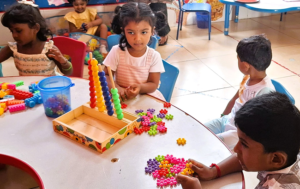
The process is gentle by design. No child is pulled aside and made to sit through a formal examination. Teachers observe during circle time, storytelling, crafts, and outdoor play. They note what a child does naturally, and that information shapes how the class is taught going forward.
Wondering whether your child is ready for this journey? Read: 5 Signs Your Child Is Ready for Preschool Admission.
How Can Parents Use Assessment Results?
When a teacher shares your child’s assessment report with you, it can feel overwhelming if you do not know what to look for. Here is a practical way to read and use that information:
- Ask the teacher to walk you through the findings. A good teacher will explain what each area means in plain language.
- Focus on growth, not perfection. The goal is to see progress from one checkpoint to the next, not to compare your child with peers.
- Ask what you can do at home. Simple activities like reading aloud, building with blocks, or singing together directly support the skills assessed in preschool.
- If a concern is flagged, treat it as a helpful early signal. Early support, whether through classroom adjustments or professional guidance, makes a meaningful difference.
For insights on how preschool children receive personalised attention, read: Can Preschool Kids in Madurai get personalised attention?.
Frequently Asked Questions
1. What is the difference between a preschool assessment and a school readiness test?
A preschool assessment tracks ongoing developmental growth across an academic year. A school readiness test is a one-time evaluation, usually conducted before entry into primary school, to check if a child is prepared for formal learning. Both have their uses, but regular assessments provide much richer, more actionable data.
2. How often should preschool assessments take place?
Three times per academic year is the standard: at the start, midpoint, and end. This rhythm allows teachers to see real progress and adjust their approach across the year.
3. Should I prepare my child before an assessment?
No preparation is needed. Preschool assessments capture natural behaviour, so there is nothing to study or rehearse. The best thing you can do is ensure your child is well-rested, had a good meal, and feels happy that morning.
4. What happens if my child’s assessment shows a delay in a specific area?
Teachers will share their observations with you and suggest targeted support, which may include classroom activities, specialist referrals (for speech or motor development), or simple strategies to practise at home. An identified delay at age 3 or 4, with timely support, carries a very positive long-term outlook.
5. Are preschool assessments the same across all schools?
No. Each school designs or adopts its own assessment framework, aligned with its curriculum and philosophy. The best schools ensure their tools are developmentally appropriate, observation-based, and communicated clearly to parents.
Admissions Open at Vikaasa School
Vikaasa School has been nurturing children in Madurai for over 55 years. Our preschool programme is built on a play-based, child-centred philosophy with structured assessments to ensure every child thrives.