
Key Takeaways
- Montessori Education is a child-centred approach that encourages children to learn through curiosity, exploration and hands-on experiences at their own pace.
- The Montessori method nurtures more than academics, helping children develop independence, confidence, concentration, social skills and emotional resilience from an early age.
- Prepared learning environments and mixed-age classrooms allow children to learn collaboratively while building responsibility, leadership and problem-solving skills.
- Montessori Education supports every stage of early development, with activities and learning experiences tailored to children’s changing developmental needs.
- Vikaasa’s preschool programme embraces Montessori-inspired principles, creating a nurturing environment where children build a strong foundation for lifelong learning and holistic growth.
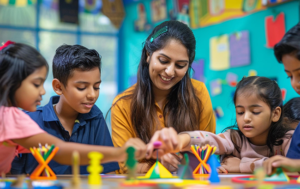
Imagine a classroom where a 5 year old chooses what to learn next. Where a seven-year old helps a younger child through a maths puzzle; not because they were asked; but because they genuinely want to.
Where no one is told to sit still and listen; instead, everyone is busy doing, exploring, building, and figuring things out for themselves. That is Montessori Education and once you understand what’s actually happening in that room, it’s hard to unsee it.
What Exactly Is Montessori Education?
So, what is Montessori Education? It is a child-centred educational approach developed by Italian physician and educator Dr Maria Montessori in Rome in 1907. It is built on one powerful belief: children are naturally curious, intrinsically motivated, and entirely capable of directing their own learning when given the right environment and freedom to do so.
Rather than delivering knowledge from the front of a classroom, Montessori educators act as guides by setting up a carefully prepared environment and stepping back to let children lead. The result is learning that comes from genuine interest rather than obligation. This is why Montessori students often develop a relationship with learning that stays with them long after school ends.
How Does Montessori Education Actually Work?
| Principle | What It Looks Like in Practice |
| Child-led learning | Children choose their own activities within a structured environment |
| Mixed-age classrooms | Younger children learn from older peers; older children reinforce their knowledge by teaching |
| Hands-on materials | Tactile, concrete learning tools rather than abstract instruction |
| Uninterrupted work periods | Long blocks of focused, undisturbed exploration time |
| Intrinsic motivation | No grades, gold stars, or competitive rankings — the reward is mastery itself |
| Holistic development | Academic, social, emotional, and practical life skills developed together |
The environment is everything in a Montessori classroom. Every material has a purpose, every shelf is accessible to the child, and every space invites independent exploration for their overall development.
What Are the Montessori Education Benefits?
The Montessori education benefits are well-documented and wide-ranging.
- Independence and self-confidence: Children understand how to make decisions, solve problems, and trust their own capabilities from an early age.
- Deep concentration: Extended, uninterrupted work periods build genuine focus that serves children throughout their entire academic life.
- Love of learning: When children choose what they explore, curiosity becomes a habit rather than something that has to be coaxed out of them.
- Strong social skills: Mixed-age classrooms teach empathy, leadership, and collaboration naturally and continuously.
- Academic achievement: Multiple studies have found Montessori students consistently demonstrate strong literacy, numeracy, and executive function skills.
- Emotional regulation: Children understand and manage their feelings and resolve conflicts in a respectful, guided environment.
As of June 2026, there are 5,039 Montessori schools across India, reflecting the growing recognition among Indian parents about the effectiveness of this approach.
Which Age Groups Does Montessori Education Serve?
Montessori education is structured across distinct developmental stages; each is designed to meet children where they are.
| Stage | Age Range | Focus |
| Infant/Toddler | 0–3 years | Sensory exploration, language, practical life |
| Primary (Children’s House) | 3–6 years | Independence, concrete learning, social skills |
| Elementary | 6–12 years | Abstract thinking, research, collaborative projects |
| Adolescent | 12–15 years | Identity, community engagement, self-directed projects |
How Does Vikaasa Incorporate a Child-Centred Approach in Its Preschool Programme?
Montessori Education is not a trend. It is a proven, globally respected approach to early childhood learning that nurtures independent, curious and confident young people.
When searching for the best schools in Madurai, take early childhood development seriously. Vikaasa’s campuses offer families a thoughtful, structured, and genuinely enriching environment in which young children can thrive.
At Vikaasa, the foundation of early childhood education is built around the compelling principles of Montessori learning – child-centred learning, exploration-based activities, and genuine holistic growth. The Vikaasa Preschool Programme is designed to nurture curiosity, independence, and confidence from the earliest years of a child’s life.
Vikaasa is also among the most trusted international schools in Madurai, having introduced the ICSE syllabus and affiliating with Cambridge University for IGCSE and A Levels. The school offers a continuum of quality education from preschool all the way through to senior secondary.
Enquire today or visit our campuses page to offer the right Montessori learning to your child!
FAQ
1. What is Montessori Education and what it focuses on?
Montessori Education is a child-centred learning approach focusing on self-directed exploration, hands-on materials, and holistic development in a prepared environment.
2. What are the key Montessori education benefits for young children?
It includes stronger independence, deeper concentration, genuine love of learning, excellent social skills and consistently strong academic outcomes across literacy and numeracy.
3. Is Montessori Education suitable for all children?
Yes. The approach is designed to meet each child at their individual developmental stage; making it particularly well-suited to diverse learning styles, paces, and personalities.
4. How is Montessori Education different from traditional schooling?
Traditional schooling is largely teacher-directed and exam focused. Montessori Education is child-led, focusing on lasting development rather than short term performance metrics.