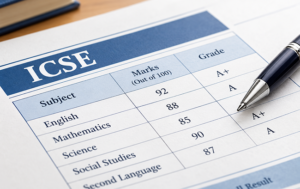

Key Takeaways
- GPA (Grade Point Average) converts letter grades into a single number that summarises overall academic performance
- Each letter grade (A, B, C…) is assigned a grade point; GPA is the average of these points across subjects, sometimes weighted by credit hours
- Most GPA scales run 0 to 4.0, but this varies by country and institution, so it’s important to check which scale is being used
- GPA is widely used in the USA, Canada, and parts of Europe and Australia, and is often required on international college and scholarship applications
- GPA differs from percentage: GPA is a standardised point average, while percentage is a raw score out of 100. GPA is easier for cross-country comparisons
- In India, the equivalent system is CGPA (Cumulative GPA), used on a 10-point scale by over 900 universities under the UGC’s CBCS system since 2015
- Common GPA scales worldwide include 4.0 (US), 5.0 (honours courses), 10-point (India and Asia), and 7-point (some Australian universities)
- Universities often convert percentages or foreign GPAs into their own scale during admissions
Have you ever seen a report card with a number like 3.8 instead of marks or percentage and wondered what that might be. That number is called a GPA. It appears easy to comprehend, but it could be confusing in the beginning. This glossary describes more in-depth about what is GPA and where it is applied.
What is GPA?
What does GPA mean, really? GPA stands for Grade Point Average. It is a simple number that shows and tells how a student is performing in their school or college. It is based on the average of a student’s grades across all subjects in a semester or academic year. Instead of filling in the marks for every subject, GPA turns your grades into one easy number. Think of it as a report card score. Each letter (like A or B) gets a number value called a “grade point”. GPA adds up these numbers and finds the average. A higher GPA means better overall performance.
How Is GPA Calculation Done?
GPA calculation is way easier than it sounds. Here are some simple steps on how you can calculate your GPA score.
- Each subject in your semester gets a letter grade, like A, B, or C.
- Each letter gets a number, called a grade point.
- Some subjects may account for more than the rest if they have more “credit hours”.
- All grade points are added up and divided by the total number of subjects (or credits).
Here is a simple example on a common 4-point scale for better understanding:
| Subject | Grade | Grade Point |
| Maths | A | 4.0 |
| Science | B | 3.0 |
| English | A | 4.0 |
| History | B | 3.0 |
If you add these points and divide them by 4 you will get a GPA of 3.5.
Where Is GPA Used?
GPA is used at many places around the world especially at:
- Schools and universities in the USA and Canada.
- Some international curriculum and universities in Europe and Australia.
- Colleges that ask international students to provide their GPA on applications.
- Scholarship forms and exchange programs that need a common metric to compare the performance of candidates from different countries.
Most GPA scales go from 0 to 4.0, though some countries use different number scales, so it always helps to check what scale a form is asking for.
GPA vs Percentage
Students often confuse GPA with percentages, but they measure academic performance differently.
| GPA | Percentage |
| Represents average grade points | Represents marks obtained |
| Standardised grading system | Raw score out of 100 |
| Common in universities worldwide | Common in school education |
| Easier for international comparisons | Varies across boards and schools |
A lot of universities, particularly foreign universities convert percentages into GPAs during admissions, especially for international students.
Why Is the Importance of GPA Different in India?
In India, most schools and colleges use a similar idea but instead of GPA, they call it CGPA (Cumulative Grade Point Average).
- In 2015, the University Grants Commission (UGC) launched the CBCS system of evaluation based on 10-point CGPA.
- Presently, this system is being followed by more than 900 universities across the country, including many central and state universities.
- Similar concepts have been taken up by CBSE for Class X reports in the past.
And thus, the main advantage of GPA (CGPA) is that it gives a fair and quick means of comparing the performances of students without analyzing mere marks.
GPA Scales Around the World
Although GPA is a universal concept, grading scales differ across countries and institutions.
Some common GPA scales include:
- 4.0 Scale: Popular in the United States and many international universities.
- 5.0 Scale: Used by some schools offering advanced or honours courses.
- 10-Point Scale: Common in India and several Asian countries.
- 7-Point Scale: Used by certain Australian universities.
Because grading systems vary, universities often convert GPAs into their own accepted format during admissions.
A Note From Vikaasa School
Knowing concepts such as GPA and CGPA gives students the confidence they need in their education, regardless of which schooling system they are in. Vikaasa has the same approach to education as it never shies away from providing its students with support and guidance to make their academic journey easier. When searching for Madurai schools, one can find Vikaasa in different localities in the city starting with Vikaasa Jubilee School located in K Pudur Madurai and Vikaasa World School, which is one of the well-known IGCSE schools in Madurai. People looking for schools in Villapuram Madurai can reach any of the Vikaasa branches nearby so as to get a better understanding of education in general. Enquire here
FAQs
-
What does GPA Stand for?
GPA stands for Grade Point Average, which is a number that represents a student’s performance on average in terms of subjects.
-
How is GPA calculated?
Each subject’s grade point is multiplied by the credit hours it carries, if any; the resultant values are added together, and the sum is divided by the total number of credit hours or subjects.
-
Is GPA different from percentage?
Yes, GPA differs from percentage. It is the average of all grade points of a student in terms of grade point average, whereas percentage is calculated on a scale of 100. GPA is used worldwide for higher studies, and percentage is used in schools.
-
What is the difference between GPA and CGPA?
There is no much difference between GPA and CGPA. It is just GPA is the short form of Grade Point Average and CGPA is the short form of Cumulative Grade Point Average. For your knowledge, in India, GPA follows the 10-point system, whereas, in other countries, it follows the 4-point system.
-
Why do I need to know about my GPA?
Some colleges ask for your GPA or percentage while you apply to them, and it is essential to calculate your cumulative GPA score based on your grades. GPA is required while shortlisting candidates for colleges and universities abroad.
-
Do other countries follow the same GPA system?
The GPA system followed in other countries varies. Some countries follow the 4 point, 5 point, 7 point, and 10 point grading systems. Your GPA will be converted in accordance with the university’s grading system.