

What is the IGCSE Curriculum
The IGCSE (International General Certificate of Secondary Education) syllabus is one of the most widely adopted international curricula, used by many schools in India. It is renowned for its inquiry-based approach to learning and pushing students to reach the highest summits in life.
IGCSE is a two-year programme designed by the Cambridge Assessment International Education (CAIE) for students aged between 14 and 16. It offers students the flexibility to choose subjects from languages, sciences, mathematics, humanities, and creative arts.
With over 70 subjects, including 30 languages to choose from, students can leverage their strengths, likes, and dislikes to achieve academic excellence. Cambridge IGCSE develops learner knowledge, understanding and skills in:
- Subject matter expertise
- Applying knowledge and understanding to new as well as familiar situations
- Intellectual enquiry
- Flexibility and responsiveness to change
- Working and communicating in English
- Influencing outcomes
- Cultural awareness.
What are the IGCSE Subject Groups
The Cambridge IGSE subjects are grouped under six categories:
- Group 1: Creative and Professional Studies
- Group 2: English Language and Literature
- Group 3: Humanities and Social Sciences
- Group 4: World Languages
- Group 5: Advanced Mathematics
- Group 6: Sciences
It can be gruelling to determine which subjects to choose, especially if you are given one too many options. The following section will guide you step-by-step in making informed choices, tailored to your capabilities and mastery.

How to Choose Your IGCSE Subjects
1. Research Your Subjects
It can be daunting, but it is the most crucial step in determining your learning trajectory for another two years.
- Visit the official IGCSE website, and list out all the subjects they offer. If needed, write them down.
- Spend dedicated hours trying to understand each subject.
- Use AI tools to streamline and expedite your research.
- Create a visual board of what the next two years will bring if you choose sciences, mathematics, or language.
2. Make a SWOT Analysis
It becomes easier to understand what IGCSE is when you do a comprehensive SWOT (Strengths, Weaknesses, Opportunities, and Threats) analysis.
- Make a list of your core strengths. Are you good with numbers? Does in-depth research into poems and imagery excite you? Or are you a musically aligned person? Answer these questions with utmost diligence to arrive at a concrete conclusion.
- Identify where you struggle, areas that need improvement, and the subjects you may need to pay extra attention to.
- Map out career pathways from your SWOT analysis.
- Plan for college, too. If your goal is to study engineering, then choose STEM; else, go for relevant subjects based on your goals for higher studies.
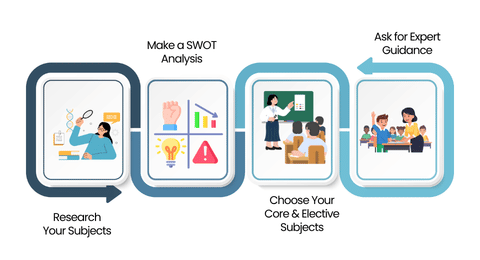
3. Choose Your Core & Elective Subjects
The IGCSE syllabus requires every student to select their core and elective subjects. The core subjects are the foundational, mandatory ones, such as English, Science, and Mathematics.
The elective subjects are optional subjects chosen based on a student’s career aspirations and interests. It includes Humanities and Social Sciences, as well as Creative, Technical, and Vocational subjects.
4. Core subjects
- English: You can choose either English Language or English Literature.
- Mathematics: Available as core and extended levels
- Science: You can choose between Biology, Chemistry, and Physics.
5. Elective subjects
- Humanities and Social Sciences: History, Geography, Economics, and Global Perspectives.
- Creative, Technical, and Vocational: Art & Design, Business Studies, Computer Science, Drama, and Music.
- Other Sciences: Environmental Management, Marine Science, or Physical Science.
- Languages: Regional Language or Foreign Language options.
6. Ask for Expert Guidance
Remember, you don’t have to do all this alone. Talk to your teachers, parents, and guidance counsellors. Get help whenever you feel stumped. Don’t feel pressured to do everything at once. Take your time, evaluate your options, make diligent choices, and run everything by the people you trust. Sometimes, peer groups motivate you better than anybody else.
How Vikaasa Guides Students in Choosing IGCSE Subjects
At Vikaasa, teachers and counsellors help students understand each subject group, review their strengths, and connect choices to future goals. Teachers encourage the students to explore their interests through inquiry-based learning and short projects before finalising subjects. They interact regularly through discussions, aptitude checks, and parent sessions, making the process easy and transparent. Parents also become part of the process through orientation sessions, allowing them to support their child’s journey. By introducing learners to the Cambridge IGCSE syllabus, Vikaasa ensures every student knows what to expect and how to prepare. As one of the leading IGCSE schools in Madurai, it focuses on building confidence and clarity before students finalise their subjects.
Conclusion
Choosing IGCSE subjects takes time, reflection, and support. Start early, ask questions, and explore different paths before making a decision. The IGCSE syllabus is designed to help you think independently and apply what you learn to real-life situations. With the right mindset and guidance, you can select a combination of subjects that aligns with both your strengths and your plans. Remember, what you choose now shapes how you learn in the future.