
Introduction
Choosing the right curriculum for your child’s education is an important decision that shapes their future. The International General Certificate of Secondary Education (IGCSE) offered by Cambridge Assessment International Education is emerging as a preferred choice for parents across the globe. The IGCSE curriculum focuses on nurturing a student’s individual talents right from the early years. It offers young learners the flexibility to explore their interests, build real-world skills, and gain an international perspective.
As students transition from preschool to primary classes, the student-centric IGCSE program can provide them with a strong foundation for higher education and global careers. Let’s examine some of the key IGCSE benefits for young students.
Benefits of IGCSE Curriculum
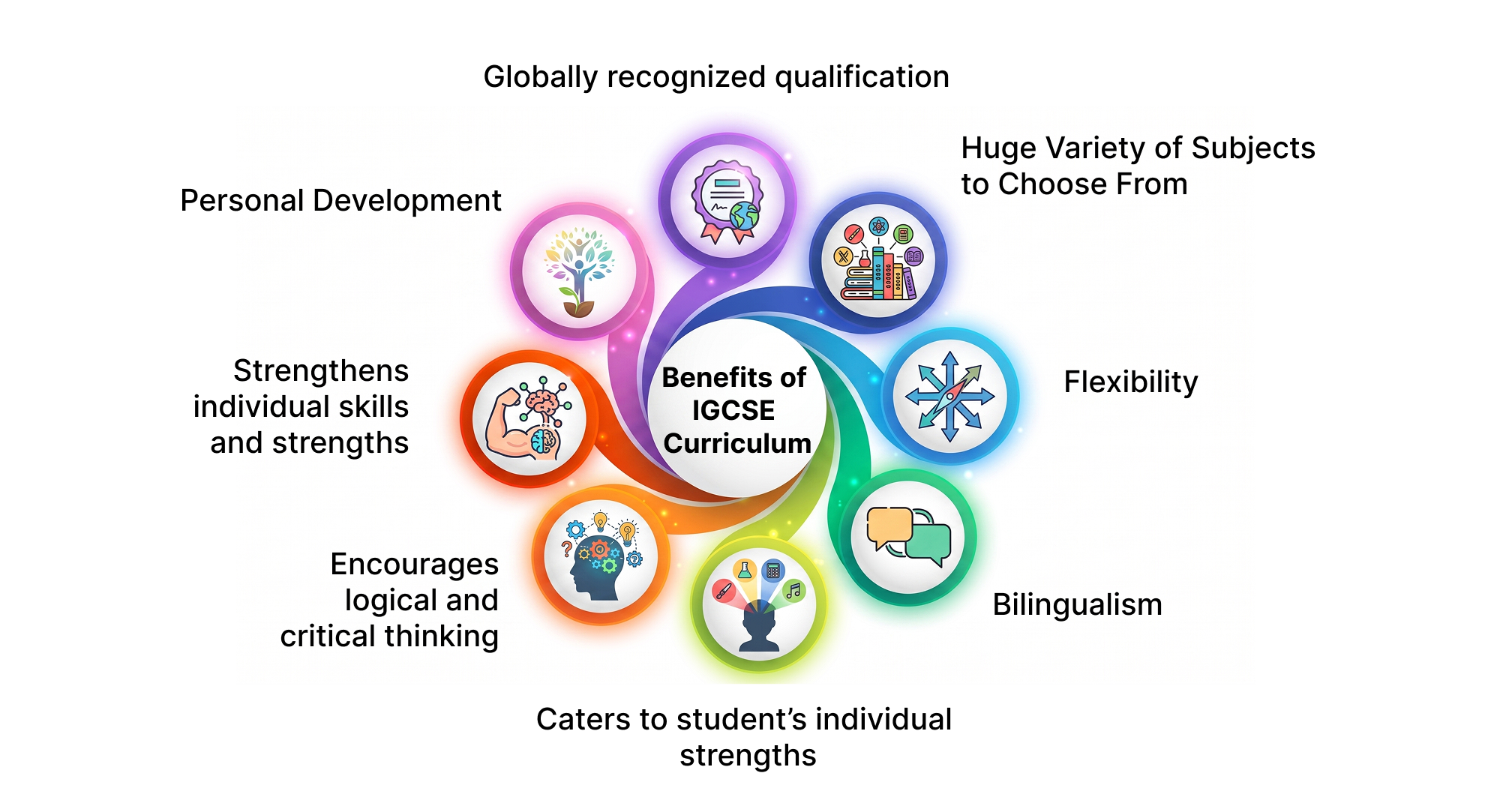
The following are some of the advantages of IGCSE curriculum:
-
Globally recognized qualification
The IGCSE is an internationally recognized qualification offered by Cambridge Assessment International Education. It is valued by over 3000 educational institutions and employers in more than 150 countries around the world. Choosing IGCSE in the early secondary school years provides students with a prestigious credential that gives them an advantage when applying to universities or jobs globally. Since the IGCSE has wide international acceptance, students who earn this qualification will have geographical flexibility in their future academic and career pursuits.
-
Strengthens individual skills and strengths
The IGCSE curriculum recognises that every student has unique skills and strengths. It allows learners to select subjects at different difficulty levels that match their individual abilities and interests. By pursuing admission in preschool, students can develop confidence and motivation.
IGCSE assessments also focus on evaluating mastery of topics rather than memorisation skills. This student-centric approach helps boost academic performance. Additionally, the practical nature of IGCSE coursework helps strengthen valuable life abilities like analytical thinking, communication talents, and problem-solving aptitudes. By letting students play to their strengths, IGCSE empowers them to thrive both academically and professionally.
-
Flexibility
One of the biggest advantages of IGCSE is it offers students the freedom to personalise their learning path. Students can switch between subjects and levels of difficulty without negatively impacting their overall grade achievements. This flexibility allows young learners to navigate and shape their academic journey over time, according to their evolving talents and future ambitions. For example, a student can take Core English in year 10 and then switch to Extended English in year 11 if they excel and wish to challenge themselves further. The IGCSE curriculum caters to students’ emerging skills and interests.
-
Bilingualism
The range of language courses offered in the IGCSE curriculum supports bilingual proficiency from an early age. Learning additional languages broadens students’ cultural perspectives and strengthens cognitive skills, which can lead to better academic achievement. Becoming competent in multiple languages also makes students more employable in today’s global job market, as multinational companies increasingly value bilingual and multilingual applicants.
-
Caters to student’s individual strengths
The IGCSE curriculum acknowledges multiple intelligences and talents in students and hence offers subjects across 5 major areas – Languages, Humanities, Sciences, Mathematics and Creative & Professional subjects. Learners can capitalise on their problem-solving abilities, logical thinking, creativity, linguistic flair or other innate capabilities by choosing suitable subjects from these domains that play to their individual strengths.
This specialised focus, allowing students to pursue subjects they enjoy and excel in, boosts their confidence and motivation. Moreover, IGCSE assessments are designed to evaluate students’ mastery and understanding rather than rote learning, further enabling them to showcase their talents. Overall, the range of subject choices and assessment patterns help channelize students’ potential towards future success.
-
Encourages logical and critical thinking
The problem-solving approach and investigative methods used in IGCSE classrooms promote the development of critical thinking skills. Through analysing real-world scenarios, evaluating data and evidence, and engaging in open discussions, students learn how to think logically and arrive at well-reasoned conclusions. These crucial skills prepare pupils for the demands of higher education and future careers.
-
Huge Variety of Subjects to Choose From
The extensive bouquet of over 70 subjects gives learners a peek into diverse interests before streamlining specialisations. The choice available across disciplines like sciences, mathematics, humanities, languages, arts, music, business studies allows discerning one’s own aptitude and passion areas early on.
-
Personal Development
The IGCSE curriculum aims to develop well-rounded individuals by assessing students not just on academic performance but also on key personal skills. These include communication, collaboration, time management, curiosity, and leadership. Tracking progress on these parameters over time helps students grow into socially aware and responsible global citizens. The focus on all-encompassing development ensures IGCSE students evolve into poised, compassionate and contributing members of society.
Conclusion
In a fast-changing global landscape, the benefits of IGCSE curriculum emerge as a future-forward choice for young learners embarking on their academic journey. With its international portability, personalised subject combinations and stress on all-round development, the IGCSE advantages enable young students to discover their innate talents and chart an inspired education pathway.