
Ever watched a toddler wrestle a spoon into their mouth, spill half the rice and grin like they have just won an Olympic medal? That small and messy triumph is actually a big developmental milestone in disguise. Curious what is really going on in those tiny fingers? Let us unpack it.
What Is Fine Motor Skill?
Fine motor skills refer to the coordinated use of small muscles in the hands, fingers and wrists to perform precise movements, such as buttoning a shirt, holding a crayon or picking up a single pea with a fork. Unlike gross motor skills, involving larger muscle groups like legs and arms, fine motor development happens quietly, one small, deliberate movement at a time.
- Grasping and releasing objects
- Hand-eye coordination
- Finger dexterity and control
- Bilateral coordination, using both hands together
Why Does Early Childhood Matter So Much for This Skill?
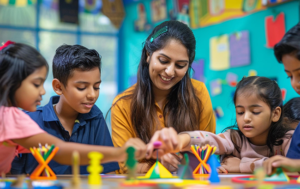
Early Childhood, roughly ages one to six, is when the brain forms neural connections at its fastest rate. This is precisely why early childhood education places such a deliberate emphasis on activities like block-building, threading beads, and clay moulding; they are not just play, they are neurological training.
As per the National Curriculum Framework for the Foundational Stage, developed by NCERT, fine and gross motor development are explicitly named as core learning outcomes for India’s youngest learners, right alongside early literacy and numeracy.
How Do Fine Motor Skills Actually Develop?
| Age Range | Typical Fine Motor Milestone |
| 12-18 months | Holding a crayon with a fist grip |
| 2-3 years | Turning pages, stacking blocks |
| 3-4 years | Using scissors with guidance |
| 4-5 years | Drawing shapes, buttoning clothes |
| 5-6 years | Writing letters, tying shoelaces |
It is found that Indian kindergarten children who engaged in a 12-week structured, sensory-rich motor programme showed measurably stronger fine motor outcomes than those in conventional classrooms alone, a genuinely encouraging sign for play-based approaches.
Why Should Parents Actually Care About This at Home?
Struggling with a fussy eater who cannot hold cutlery, or a child who dreads handwriting practice? These frustrations are often fine motor struggles in disguise, not stubbornness. The good news is that daily life is already full of opportunities to help.
Everyday tips that genuinely help
- Letting your child help with cooking, kneading dough or peeling vegetables builds real hand strength.
- Offer tongs or clothespins for simple sorting games.
- Encourage lacing cards or beading before formal writing practice begins.
- Resist the urge to always do buttons and zips for them; a little struggle builds skill.
Which Everyday Activities Build These Skills Best?
- Playdough and clay modelling
- Cutting with child-safe scissors
- Puzzle assembly
- Drawing, colouring, and tracing
- Simple building blocks and construction toys
Where Can Parents See This Approach Done Well?
Schools that treat fine motor development as a genuine curriculum priority, not an afterthought, tend to raise noticeably more confident young writers. Vikaasa’s preschool education programme weaves purposeful, play-based motor activities into everyday classroom routines from day one. Among the best schools in Madurai, we remain especially proud of our legacy where generations of children have built these foundational skills.
Who Should Consider This When Choosing a School?
Parents comparing International schools in Madurai or top ICSE schools in Madurai should ask specifically how early years classrooms structure motor-skill activities, not just academics. Vikaasa’s ICSE curriculum and World School both build on this early foundation as children progress through the years.
Why Choose Vikaasa for Your Child’s Early Years?
Choosing the right early years foundation shapes far more than academics; it shapes confidence, curiosity and lifelong learning habits. With over 55 years of legacy, Vikaasa blends purposeful, play-based learning with genuinely experienced early years educators who understand exactly how young hands and minds grow together. From hands-on motor-skill activities to a nurturing, globally aligned curriculum, Vikaasa gives your child the strongest possible start.
Ready to see it for yourself? Enquire about admissions at Vikaasa today, and give your child a foundation built to last.
FAQs
1. How do fine motor skills differ from gross motor skills?
Fine motor skills involve small muscles in the hands and fingers, like grasping, while gross motor skills use larger muscles for actions like running, jumping, or climbing.
2. What are the early signs that a child may need extra support with fine motor skills?
Difficulty holding a spoon, avoiding drawing or colouring or struggling with buttons well past the expected age can signal a need for gentle and extra support.
3. Can excessive screen time affect fine motor skill development?
Yes, prolonged screen time often replaces hands-on play, which is genuinely essential for building grip strength, coordination and finger dexterity in young children.
4. Do all children develop fine motor skills at the same pace?
No, every child develops at their own pace, influenced by genetics, practice opportunities and individual temperament, so gentle variation is entirely normal.
5. Are fine motor skills linked to later academic performance?
Yes, strong fine motor control is closely linked to ensure smoother handwriting, better classroom focus and greater confidence during early literacy and numeracy learning.