
What is a Group Discussion (GD)?
A group discussion is a structured, student-centred dialogue where students engage in structured conversations around specific topics, problems, or concepts. It is an interactive approach that encourages students to exchange ideas, challenge assumptions, and collectively construct knowledge.
In literature reviews, group discussions are categorised under the headings of “cooperative learning” and “peer instruction.” A comprehensive meta-analysis across 122 studies by Johnson, Maruyama, Johnson, Nelson, and Skon (1981) found that cooperative learning consistently produces superior achievement outcomes compared to competitive and individualistic learning structures.
The Science Behind Group Discussions
The effectiveness of group discussions is not merely anecdotal—it’s rooted in decades of empirical research. For instance, Eric Mazur, a renowned physicist at Harvard, introduced a new teaching framework called Peer Instruction in his science classes in the early 90s. In a typical Mazur-style peer instruction cycle:
- The teacher poses a conceptual question.
- Students think and respond individually.
- They discuss their reasoning with peers.
- The class votes again, often showing a dramatic improvement.
A landmark scientific study by Smith et al. (2009) found that correct responses to a question or a concept increased from 40% to 74% after peer discussion without any teacher explanation.
A broader review by Vickrey et al. (2015) confirmed that peer instruction leads to stronger conceptual understanding and retention across disciplines.
The model mirrors Vygotsky’s Social Development Theory, which emphasises that learning occurs through social interaction and scaffolding within the Zone of Proximal Development, where peers help one another reach higher levels of understanding.
At Vikaasa, group discussion protocols are based on the peer-instruction framework: students first think independently, then engage collaboratively with their peers, and finally refine their conclusions under the guidance of the teacher. It is a three-step process that strengthens reasoning, self-reflection, and articulation, adopting the core goals of both the Cambridge IGCSE programme and the ICSE syllabus.
Benefits of Group Discussions
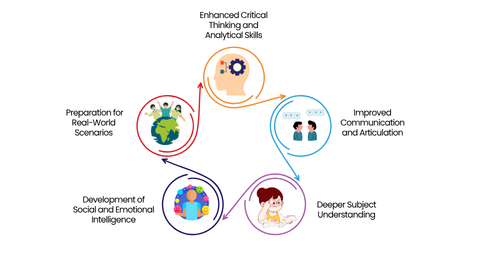
1. Enhanced Critical Thinking and Analytical Skills
Group discussions encourage learners to question assumptions, evaluate multiple viewpoints, and support their ideas with evidence. It strengthens reasoning and helps students move beyond surface-level recall to deeper analysis.
At Vikaasa School, discussion prompts are designed to challenge students to think independently and assert logical, well-supported arguments.
2. Improved Communication and Articulation
Through structured dialogue, students learn to listen actively, articulate thoughts clearly, and express opinions respectfully. Regular participation in group discussions enhances their clarity, organisation, and persuasive speaking skills that serve them well in academics, leadership, and daily life.
3. Deeper Subject Understanding
Explaining a concept to peers helps students reinforce their own comprehension, a principle known as the protégé effect. By verbalising what they learn, they retain knowledge more effectively and make meaningful connections across topics.
At Vikaasa, discussion-based learning within the ICSE syllabus ensures students don’t simply memorise facts. Instead, they internalise ideas, reflect on them, and understand concepts.
4. Development of Social and Emotional Intelligence
Group discussions cultivate empathy, patience, and confidence in collaboration. Students learn to value diverse perspectives, manage disagreements constructively, and foster positive relationships with their peers.
At Vikaasa, alternating roles between speakers, summarizers, and challengers ensures that every child experiences both leadership and teamwork.
5. Preparation for Real-World Scenarios
The ability to communicate effectively and work collaboratively is a cornerstone of modern education and professional life. Group discussions simulate real-world environments where teamwork, adaptability, and apparent communication drive success.
By practising these skills early, students graduate with not only academic confidence but also with the interpersonal strengths that employers and universities value most.
Creating Effective Group Discussions: Key Principles
Research by Brookfield & Preskill (2005) in Discussion as a Way of Teaching identifies four key ingredients for successful Group Discussions:
- Clear Ground Rules: Establish respect, listening norms, and time limits.
- Purposeful Questions: Pose open-ended, thought-provoking prompts that encourage deeper reflection.
- Equal Participation: Ensure all voices are heard through role rotation.
- Closure with Reflection: Summarise insights and link to future learning.
How Vikaasa School Implements Group Discussions
As one of the best international schools in Madurai, Vikaasa integrates group discussions into daily classroom practice through:
- Structured Facilitation: Teachers guide but don’t dominate discussions, setting clear objectives and balanced participation.
- Diverse Grouping: Students are grouped across a range of abilities and backgrounds to ensure exposure to diverse viewpoints.
- Cross-Curricular Integration: Group discussions are used in science debates, literature circles, and social-science case studies alike.
- Assessment Integration: Participation and reasoning quality contribute to the effectiveness of formative assessment.
- Reflective Closure: Sessions end with individual reflection or written summaries, reinforcing retention.
Conclusion
The evidence is overwhelming: group discussion is not a passing trend but a lynchpin of effective pedagogy. It fosters critical thinking, collaboration, empathy, and confidence required in a global, interconnected world.
At Vikaasa School, research-backed group discussions are integrated into the ICSE programme to prepare students for academic excellence and a life beyond the classroom walls.