
Let’s start with something familiar.
“Twinkle, twinkle, little star…”
Before children can read words or form sentences, they sing. They clap. They repeat. They giggle. And somehow; almost magically; they begin to learn language.
That magic is not accidental. It is the power of rhymes.
In this guide, we will explore how rhymes help in language development and why they matter so deeply in the early years. We will also cover why schools that prioritise rhyme-based learning often see stronger communication skills in children.
So, let’s sing our way into learning.
What Are Nursery Rhymes?
Let us clear this up first.
What are nursery rhymes?
They are short and rhythmic verses often paired with actions, repetition and melody. Think simple words, predictable patterns and playful sounds.
But don’t mistake simple for basic.
Nursery rhymes are one of the earliest and most powerful language-learning tools children experience; even long before textbooks enter the picture.
In top-reputed preschools in Madurai; nursery rhymes are treated as learning tools and not fillers between lessons.
Why Do Children Instantly Connect With Rhymes?
Have you noticed how easily children memorise rhymes compared to regular sentences? Rhythm, repetition and melody work together to capture attention, trigger curiosity and make language learning feel playful, memorable and emotionally comforting.
That’s because rhymes:
- Use repetition
- Follow predictable patterns
- Combine sound, movement and emotion
This combination activates multiple areas of the brain at once; making learning feel effortless and fun. That is also why nursery rhyme music plays such a big role in early classrooms. Music turns language into an experience.
The Importance of Nursery Rhymes in Early Learning
The importance of nursery rhymes goes far beyond entertainment. When children sing or listen to rhymes, they are quietly developing:
- Listening skills
- Sound recognition
- Vocabulary
- Sentence structure
In addition; rhymes strengthen memory, improve concentration and help children recognise patterns in language. The playful repetition builds phonemic awareness; allowing young learners to hear, predict and reproduce sounds naturally without pressure.
All of these are essential building blocks for reading, writing and speaking confidently later on. This is why educators often emphasise the importance of nursery rhymes for preschoolers as a foundation for lifelong literacy.
How Exactly Do Rhymes Support Language Development?
By age five, children exposed to daily rhymes can recognise more sound patterns, giving them a measurable head start in reading readiness. Moreover, there is a strong link between early nursery rhyme knowledge and later phonological awareness and reading ability.
A study among a group of children aged 3 to 6 years found that early familiarity with nursery rhymes was strongly related to phonological sensitivity and later success in reading and spelling.
Let us break it down in a simple, practical way.
-
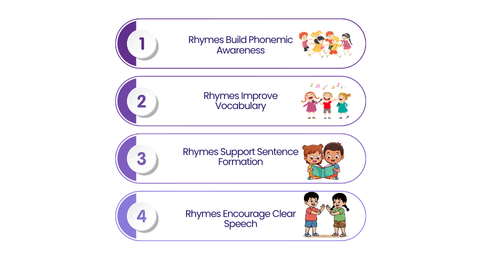
Rhymes Build Phonemic Awareness
Children begin to hear and recognise sounds such as cat, hat and bat. This sound awareness is crucial for reading later. Rhymes train young ears to notice sound patterns; making decoding words feel intuitive rather than difficult.
-
Rhymes Improve Vocabulary
New words stick better when they are sung. Children remember phrases through rhythm, not memorisation. The melody provides context, helping them understand the meaning; while enjoying the process.
-
Rhymes Support Sentence Formation
Repeated sentence patterns help children understand grammar naturally without formal instruction. They begin forming sentences by imitation, which is how language develops best at this age.
-
Rhymes Encourage Clear Speech
Chanting and singing improve pronunciation, articulation and confidence. Children practise speaking aloud in a safe and playful way, often without realising they are learning. No worksheets required.
Nursery Rhymes and Emotional Confidence
Language development is not just about words; it is also about expression.
Rhymes allow children to:
- Perform in front of peers
- Express emotions safely
- Participate without fear of being wrong
Through actions, rhythm and repetition; children build confidence, social comfort and emotional awareness. In nurturing environments like the best schools in Madurai, rhymes gently encourage even shy learners to speak up, participate joyfully and feel seen, heard and valued every single day.
10 Benefits of Nursery Rhymes
Nursery rhymes may seem simple, but they play a powerful role in shaping early language, confidence, memory and overall cognitive development. Let us explore the 10 benefits of nursery rhymes that are hard to overlook:
| Benefit | How it Helps |
| Sound Recognition | Improves listening skills |
| Vocabulary Growth | Introduces new words naturally |
| Memory | Strengthens recalling attention through repetition |
| Pronunciation | Enhances clarity of speech |
| Rhythm awareness | Supports reading fluency |
| Confidence | Encourages participation |
| Social Skills | Promotes group interaction |
| Emotional Expression | Builds comfort in communication |
| Early Literacy | Prepares for reading and writing |
| Develops Love for Learning | Makes language learning joyful |
These benefits of nursery rhymes explain why they remain a core part of early education worldwide.
Why Nursery Rhyme Music Works So Well?
Music activates both the logical and creative sides of the brain. Nursery rhyme music:
- Helps children remember words faster
- Encourages physical movement
- Makes learning multi-sensory
This is especially effective in the modern early education models aligned with global frameworks like the Cambridge International Syllabus; where holistic development is key.
Rhymes in the Classroom vs Rhymes at Home
Both matter; but structured exposure makes a difference.
In classrooms-
- Rhymes are planned around learning goals
- Actions reinforce meaning
- Teachers guide pronunciation and rhythm
At home-
- Rhymes strengthen bonding
- Repetition reinforces learning
- Children feel safe experimenting with language
Together; they create powerful reinforcement.
Recommendation– Parents seeking admission in preschool should always ask how rhyme-based learning is woven into everyday classroom experiences.
How Preschools Use Rhymes Strategically?
In many reputed preschools; rhymes are integrated intentionally.
Examples include-
- Morning welcome songs
- Action rhymes during transitions
- Story based rhymes for vocabulary
- Music-led phonics sessions
This ensures rhymes support both fun and learning outcomes.
Practical Tips for Parents and Educators
Do you want to maximise the impact of rhymes? Try these-
- Repeat favourite rhymes daily
- Add simple hand actions
- Encourage children to finish lines
- Use expression and facial cues
- Let children create their own silly rhymes
Turn rhyme time into a joyful routine during car rides, bath time or classroom transitions. Follow your child’s pace, celebrate enthusiasm and keep it playful. Remember; perfection is not the goal; participation is.
How Rhymes Prepare Children for Formal Learning?
Rhymes build readiness for-
- Reading
- Writing structure
- Confident speaking
- Classroom participation
They also strengthen memory, listening focus and early literacy confidence skills that reduce learning anxiety and improve classroom engagement. Children who grow up with strong rhyme exposure often transition smoothly into structured academic frameworks.
Why Rhymes Matter Even Today?
In the digital world of screens and fast content; rhymes help to slow things down.
They encourage and motivate children to-
- Listen
- Repeat
- Feel
- Engage
This gentle pace nurtures attention, emotional connection and joyful learning moments. Children are not rushed to perform; but; they are encouraged to participate naturally. This is why educators continue to champion the importance of nursery rhymes even in modern classrooms; where meaningful learning matters more than speed.
Final Thoughts: Language Begins With a Song
So, how do rhymes help in language development?
They don’t teach language; but, they unlock it.
Through rhythm, repetition and joy; rhymes help children fall in love with words, long before they ever write them down. And when early schools value this process; children don’t just learn language; they live it. That is the true power of nursery rhymes.
They create confidence, curiosity and connection; laying emotional and cognitive foundations that support lifelong communication, creative thinking and a genuine love for learning.