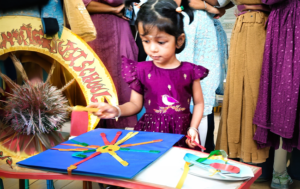

I once attended a parent observation session at my son’s school, one of the most well-known preschools in Madurai. It was my first chance to see how my child learned in class.
They were teaching the kids the alphabet, but not the way I remembered it. There was no loud “A-B-C-D” chorus, no mechanical repetition. Instead, my son was singing, “Aa… aa… aa…” before he even said the letter A.
Later, I asked the teacher about it. She smiled and explained, “Before introducing letters, we teach children sounds through phonics. So, when they understand sounds first, reading becomes natural later.”
I was amazed. It made me realise that nursery education has evolved from memorising letters to learning their sounds.
But why is phonics important, and why have schools made this change? This blog explains why schools around the world are moving away from rote memorisation and towards a sound-based approach to teaching.
What is Phonics?
Phonics is a way of teaching reading and writing by helping children become aware of sounds in words. It means learning to hear, identify, and work with the smallest units of sound, called phonemes, to tell words apart.
Simply put, phonics is about the connection between written letters (graphemes) and the sounds we speak (phonemes).
Instead of just memorising the alphabet, children learn:
- The sound each letter makes
- How sounds blend
- How spoken words map to written text
For example:
- “a” → /a/
- “b” → /b/
- “cat” → /c/ + /a/ + /t/
It converts reading from guessing into a logical process called decoding.
- Decoding: Translating written words into speech sounds (reading).
- Encoding: Translating speech sounds into written words (spelling).
Why is Phonics Important?
You might ask, “We learned just fine with the ABC song, so why change it?”
The “Simple View of Reading,” a theory proposed by researchers Gough and Tunmer (1986), highlights the importance of phonics by suggesting that Reading Comprehension = Decoding x Language Comprehension.
If a child can’t decode words, they can’t understand what they read, no matter how smart they are.
Phonics helps prevent the “Fourth Grade Slump.” Many children memorise words by their shape, seeing “cat” as a picture instead of sounding out c-a-t.
It works until about third grade. By fourth grade, when words get harder and books have fewer pictures, children who rely on visual memorising struggle. Phonics gives them the skills to read any word, whether they know it or not.
Benefits of Phonics in Early Years
Implementing phonics in international preschools is an evidence-based necessity. Here are the key benefits of phonics:
- Enhances Reading Fluency. Fluency is the ability to read a text accurately, quickly, and with expression.
When children master phonics, they don’t trip over words. They quickly recognise how words sound.
A study published in the Journal of Educational Psychology indicates that phonics instruction significantly improves the ability to read fluidly compared to non-systematic or no phonics instruction.
- Boosts Reading Comprehension. It might sound surprising. Isn’t phonics just about sounds? Yes, but research shows our brains can only handle so much at once.
If a child has to work hard to sound out every word, they have little energy left to understand what the sentence means.
Phonics makes reading automatic so that children can focus on the story itself.
- Improves Spelling. Phonics works both ways. When children learn that the sound /k/ can be spelt as ‘c’, ‘k’, or ‘ck’, they start to understand spelling rules.
They stop memorising letter patterns and begin to see the logic behind words.
- Builds Patience and Focus. Phonics needs children to listen carefully. In class, telling the difference between the short ‘a’ in apple and the short ‘e’ in egg takes concentration. Learning phonics helps improve attention and behaviour.
How is Phonics Integrated into the Curriculum?
Modern curricula, like the ICSE LKG syllabus, now focus more on building phonological awareness in their literacy lessons.
- Phase 1 – Listening: Before seeing letters, children play games to identify sounds in the environment (instrumental sounds, body percussion).
- Phase 2 – Letter Sounds: Introducing the sounds of letters, often in a specific order (like s, a, t, p, i, n) that allows them to start building words immediately.
- Phase 3 – Blending and Segmenting: Blending sounds to read (c-a-t = cat) and breaking words down to spell.
Synthetic Phonics vs. Analytical Phonics
Not all phonics methods are the same.
- Synthetic Phonics: It is the most recommended method and is what I saw at the preschool. Children learn to turn letters into sounds and then blend them to make words.
- Analytic Phonics: Here, children look at letter-sound patterns in words they already know. They don’t say each sound by itself.
Research, like the well-known Rose Report (2006) from the UK, strongly supports Synthetic Phonics as the best way to teach early reading. That’s why many progressive schools around the world use it.
Why the ABCs Aren’t Enough
During that observation session, I realised how complex English really is. We think of it as 26 letters, but there are about 44 different sounds.
That is precisely why phonics is important; it helps connect a small alphabet to many sounds.
If we only taught children the names of the letters, how would they read the word “ship”? They might say “Suh-Huh-Ih-Puh.” But with phonics, they learn that ‘s’ and ‘h’ together make a new sound: /sh/. That is called a digraph (two letters, one sound). Later, they also learn about trigraphs, like ‘igh’ in night.
Without a structured understanding of these sound combinations, a child is left guessing. Unveiling the language code is one of the primary benefits of phonics, helping prevent the confusion that can lead to reading anxiety in later years.
The Challenge of “Tricky Words”
Even the best phonics rules have exceptions. It is where things get interesting. Teachers often talk about “Sight Words” or “Tricky Words.” These are common words that don’t follow the usual phonics rules and can’t be sounded out easily.
Take words like ‘the’ or ‘was’. If a child sounds out ‘was’ using regular phonics, they might say /w/-/a/-/s/, which rhymes with ‘gas’. But we know it’s pronounced more like ‘woz’.
One of the benefits of phonics in the early years is that teachers can easily introduce these tricky words along with regular lessons.
Research shows that while phonics is important, children also need to memorise these irregular words to become fluent readers.
The key is teaching kids when to use the rules and when to spot exceptions. This way, they don’t get stuck on common words and can keep enjoying the story.
Common Myths About Phonics Debunked
Despite all the evidence showing how helpful phonics is, some myths persist among parents.
- Phonics takes the fun out of reading.
It’s actually the opposite. When children don’t have to struggle to figure out words, they can enjoy the story and imagine things like dragons and castles with the sounds they learn.
- English is too irregular for phonics.
While there are exceptions, about 84% of English words follow regular patterns. Phonics helps children read most words, making the few tricky ones much easier to handle.
Tips for Parents to Support Phonics at Home
As parents, we don’t have to be expert teachers, but we can help support what our children learn in school.
- Focus on Lowercase: Most of what we read is in lowercase letters. Teach your child the sound of the lowercase letter before the capital letter name.
- Read Aloud: Choose rhyming books, like those by Dr Seuss. Ask your child, “Cat and Hat… do they sound the same at the end?”
- Don’t Rush: If your child struggles with a sound, take a break. English can be complex. The ‘ough’ alone has more than six pronunciations! Patience is important.
Conclusion
Watching my son’s class was eye-opening. It helped me see the difference between my old way of learning and his new one. When we understand the importance of phonics, we know that we’re not just teaching kids to read words; we’re giving them the key to unlock every book they’ll ever read.
Focusing on phonics helps children not only learn to read but also love reading. That’s a gift that lasts a lifetime.