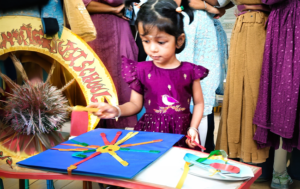

A teacher presents a math lesson. One student understands immediately when shown a diagram, while another grasps it after hearing an explanation, and the third one needs to physically manipulate objects.
That shows there is no one-size-fits-all process.
Every student in a classroom learns a little differently. Some remember everything from diagrams, some only when they hear it explained, and others need to write it out or actually do something with their hands.
These preferred ways of understanding information are called learning styles, and recognising them can transform how we teach.
In this blog, we will understand what different learning styles are, the main types, and how they support your child’s learning journey more effectively.
What is a Learning Style?
A learning style refers to the way an individual processes, understands, and retains new information. It reflects how students prefer to learn: through visuals, sound, movement, or hands-on experience.
The idea of different learning styles has shaped educational methods for decades. And recognising the child’s learning style helps teachers to adapt instruction and helps students feel understood rather than labelled.
Types of Learning Styles of Students
| Learning Style | Key Characteristics | Effective Teaching Strategies |
| Visual | Prefer images, diagrams, charts, and written instructions. | Infographics, concept maps, colour-coded notes, and video demonstrations. |
| Auditory | Learn best through listening to explanations and discussions. | Lectures, podcasts, group discussions, verbal instructions, and read-aloud activities. |
| Reading/Writing | Prefer text-based input and output. | Written assignments, essays, lists, detailed notes, and textbooks. |
| Kinesthetic | Thrive on hands-on activities and physical engagement. | Experiments, role-playing, building models, and movement-based learning. |
Why Learning Styles Matter in Education
Different learning styles in Education persist as they offer a framework for understanding how students engage with material. Educators and parents use these categories to personalise lessons, increase engagement, and support students who might otherwise struggle.
- Improve Engagement and Motivation: When lessons use varied methods like diagrams, discussions, texts, and practical activities, more students stay interested and feel included. That helps to increase attention, enjoyment, and willingness to participate actively in class.
- Understanding Diverse Learners: Learning styles highlight that students absorb information differently, through visual, auditory, reading/writing, or kinesthetic methods, helping teachers recognise and value individual differences instead of assuming one uniform way.
- Improving Comprehension and Retention: Presenting content in multiple modes gives students ways to understand ideas, making explanations clearer and helping information stick in long-term memory.
- Supporting Learner Self-Awareness: Discussing learning styles encourages students to reflect on how they learn best, develop suitable study strategies, and confidently request resources or approaches that help them understand, increasing ownership of their learning.
- Guiding Flexible Teaching Strategies: With learning styles as a guide, teachers can plan lessons that blend different activities and offer choices in how students access content and show learning, making classrooms more inclusive and student-centred.
Main Types of Learning Styles
1. Visual Learners –
These learners understand best when information is organised in images, diagrams, charts, and colour-coded notes. In the classroom, these students focus on the teacher’s board work, like concept maps in science or labelled diagrams in geography.
The best way to present to visual learners is by using slides, whiteboard sketches, mind maps, and infographics.
2. Auditory Learners –
These learners retain information more easily when they hear it spoken, through explanations, classroom discussions, debates, and read-aloud sessions. These learners often remember things when they explain topics to others or listen to recordings.
They learn best when information is presented through strategies that involve talking, such as lectures or group discussions.
3. Kinesthetic Learners –
These learners prefer to learn by doing or by understanding. They prefer experiments, models, simulations, group tasks, and movement-based activities.
The best way to help them learn is through personal experience, practical activities, hands-on experiments, examples, or simulations.
4. Reading/Writing Learners –
These learners love to consume information through words, whether it’s by writing down or reading it. They like reading from books, taking notes, writing summaries, and working through practice worksheets.
They learn best through textbooks and notes, writing summaries, and making lists & definitions.
Benefits of Different Learning Styles
- Better Understanding and Memory: Students’ understanding of their learning style makes concepts clearer and easier to remember, increasing accuracy and depth of understanding in any subject.
- Improve Academic Performance: Adapting study techniques to preferred styles helps students prepare more effectively for tests and assignments, often leading to higher grades and more consistent performance across different courses.
- Reduce Stress and Frustration: Knowing and using your learning style can make studying feel more manageable, cutting down wasted effort, anxiety & confusion.
- More Inclusive Classroom: When teachers plan for different learning styles, students feel supported, and the classroom becomes fairer.
How Progressive Schools Approach Different Learning Styles
Progressive schools understand that children do not all learn the same way, at the same pace, or through the same methods. So, instead of focusing on adapting one teaching style, these schools adapt teaching to suit diverse learning styles.
Schools use:
-
Differentiated Instruction for Learning Styles
Teachers intentionally vary methods: visual tools, auditory strategies, and hands-on tasks. Lessons often include multiple entry points so one concept is experienced in more than one way, supporting diverse styles in the same room.
Students might watch a concept demo, discuss it in groups, then build or draw something, ensuring deeper understanding for both abstract and concrete learners.
-
Project-Based Learning and Multiple Intelligence
Projects are central, letting students research, design, create, and present around real-world themes. This taps multiple intelligences at once rather than only verbal and memory skills.
For example, in a project on the environment, one student might make a model, another write a report, another design a poster or song, all showing understanding of their preferred mode.
-
Holistic, Ongoing Assessment
Instead of relying mainly on pen-and-paper exams, progressive schools use portfolios, observations, presentations, and self-assessment. These different tools let visual, verbal, and kinesthetic learners all find fair ways to show what they know.
Feedback is continuous and descriptive, which helps students understand how they learn best and how to improve, rather than just receiving marks or ranks.
-
Flexible Classroom Practices
Rather than rigid, lecture-driven classrooms, progressive schools allow flexibility in how students learn and demonstrate understanding. Group work, independent tasks, projects, and discussions coexist within the same classrooms.
Further, students may explain learning through presentations, models, or written responses. This flexibility respects different learning styles and reduces pressure on students who may struggle with traditional learning styles.
-
Personalised Teacher Support
Teachers in progressive schools act as facilitators and observers. They monitor how students respond to lessons and adjust accordingly, offering extra visuals, verbal explanations, or hands-on support when needed.
Conclusion
There are multiple different learning styles, and understanding your child’s preferred learning style is crucial for academic growth. Moreover, it also helps to improve engagement and motivation, providing a positive learning experience.
Each child has a unique combination of strengths, preferences, and potential. At Vikaasa, one of the best schools in Madurai, our approach integrates the best of learning styles research while avoiding simplification.
We recognise every child has their preferred learning style and that influences their learning experience. We combine explanatory teaching, interactive technology, project work, and hands‑on experiments to support visual, auditory, reading/writing, and kinesthetic learners.
If you are looking for an ICSE school in Madurai or higher secondary admission, do visit our website or campus to know more about us.
FAQs
1. Do children have only one learning style?
No, children can have more than one learning style, which means using a combination of learning styles such as visual, auditory, reading/writing, or kinesthetic.
2. Should Parents identify their child’s learning style?
Yes, it helps parents to better support their academic, emotional, and intellectual development.
3. Do learning-style-friendly schools improve academics?
Yes, when students learn the concept in a way that suits them, it improves engagement, motivation, and academics.
4. What are the main types of learning styles?
The main types include visual, auditory, reading/writing, and kinesthetic learners.