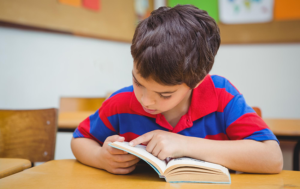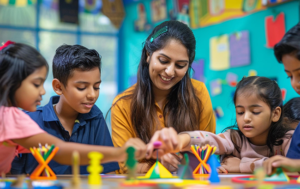

In the conventional classroom, the teacher often stands at the front of the room, disseminating knowledge while students listen and take notes. While this teacher-centered model has been the norm for decades, education is shifting toward a more dynamic, engaging, and effective philosophy: Student-Centered Learning.
But what exactly does a student-centered approach mean for your child? Simply put, it shifts the focus of instruction from the teacher to the student. It treats learners as active participants in their own education rather than passive recipients of facts.
At Vikaasa, a leading ICSE school in Madurai, we see daily how this transition empowers children to become lifelong learners.
What Is Student-Centered Learning?
The definition of student-centred learning revolves around autonomy and collaboration. In such an environment, students have a seat at the table when deciding what they learn, how they understand, and when they demonstrate their knowledge.
Instead of asking, “What am I going to teach today?” a teacher in a student-centered classroom asks, “What are my students going to do today to build their understanding?”
The Importance of Student-Centered Learning
- Increased Engagement: When students have a say in their projects, they are naturally more interested.
- Critical Thinking: Students learn to analyse, interpret, and solve problems.
- Ownership: Students take responsibility for their successes and challenges.
- Inclusivity: It allows for different learning styles, visual, auditory, and kinesthetic, to succeed simultaneously.
How to Implement a Student-Centered Learning Model
Transitioning to a student-centred learning model is a journey that involves changing the physical classroom, the curriculum, and the relationship between teachers and students. Here is how to make it happen.
Step 1: Create a Flexible Learning Environment
The physical space must support collaboration. Instead of rows of desks facing the front, a student-centered classroom often features clusters of tables, comfortable reading corners, and “maker spaces.” The arrangement allows students to move freely and work in groups, which is a hallmark of the ICSE syllabus followed at Vikaasa.
Step 2: Involve Students in Goal Setting
Start the term or a new unit by asking students what they already know and what they want to discover. When students help set their own learning targets, they feel a sense of agency, shifting “have to learn” into “want to learn.”
Step 3: Utilise Student-Centered Teaching Methods
Teachers should move from being the “sage on the stage” to the “guide on the side.” Key methods include:
- Inquiry-Based Learning: Starting with a question or a problem instead of diving right into a lecture.
- Project-Based Learning (PBL): Students work over an extended period to respond to a complex question or challenge.
- Flipped Classrooms: Students review basic concepts at home, leaving class time for active discussion and hands-on application.
Step 4: Build Collaborative Communication
In a student-centered model, classroom noise is the sound of learning. Encourage students to talk to one another, debate ideas, and peer-teach. Research shows that we retain information much better when we explain it to someone else.
Step 5: Offer Choices in Assessment
Not every child expresses knowledge best through a multiple-choice test. To honestly center the student, provide options for how they show what they’ve learned.
Student-centered learning examples include: Creating a podcast, filming a video, writing a blog post, or building a physical model.
Step 6: Use Ongoing, Formative Feedback
Instead of waiting until the end of a unit to deliver a final grade, provide continuous feedback. It allows students to pivot and improve in real time and shifts the focus from “the grade” to “the growth.”
Real-World Examples of Student-Centered Learning
To understand student-centered teaching methods, imagine a science class learning about ecosystems.
In a traditional approach, students read a chapter and label a diagram of a food chain.
In a student-centered approach, students visit a local garden, identify local flora and fauna, and then work in small teams to build a sustainable mini-ecosystem in a jar, documenting their observations over two weeks. They collect rare plant species and maintain a herbarium, which is then stored in the Biology labs for display.
Creating a sense of awe about every subject in every possible way not only excites and pushes them to learn more but also enhances their lateral thinking.
Challenges and Solutions in Student-Centered Learning
While moving to a student-centered approach is rewarding, it requires patience. Teachers must balance giving students freedom with maintaining academic rigour. The solution lies in structured liberty, providing a clear framework within which students can explore. It ensures that while students take the lead, they remain aligned with essential learning standards.
The Path Forward
Choosing a school that embraces non-traditional methods of learning is the first step in uncovering your child’s potential. For parents who consider higher secondary admissions, you must seek institutions that prioritise students’ voices and choices.
By cultivating an environment where curiosity is honoured and students architect their own education, we teach them how to think, adapt, and lead.