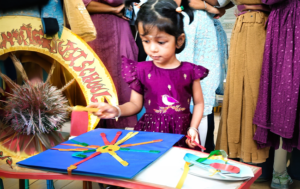

Have you ever noticed how your child points at the moon, a clock, or a pizza slice and says, “It’s round!” or “That’s a triangle!”? That’s where their journey into the world of shapes begins. Shapes are your child’s first step into understanding patterns, logic, and problem-solving. This simple skill sets the base for everything they’ll learn later in maths, science, and even art.
At Vikaasa, we believe that when children explore shapes, they’re not just identifying figures but discovering how the world fits together. Our classrooms are filled with colour, creativity, and curiosity, helping young learners connect what they see with how they think. In this easy guide, we’ll walk you through names of shapes with pictures, why they matter, fun activities to try at home, and how shape learning forms a strong foundation for your child’s education.
Why Learning Shapes Matters for Kids
Every time your child points out a circle or a square, they’re taking a big leap in understanding the world around them. Recognising shapes sharpens memory, observation, and problem-solving. It’s a small skill with huge benefits.
- Shapes Help Kids Understand the World
From the round clock on your wall to the rectangular door, shapes are everywhere. When children recognise them, they start connecting objects, distances, and directions. This spatial understanding is the base for tasks like reading maps, building with blocks, or organising their toys. These small discoveries nurture independence and confidence.
- Boosts Early Maths and Logical Thinking
When your child learns to tell the difference between a triangle and a square, they’re learning to compare, group, and reason. These are the same mental skills used in maths. Understanding basic types of shapes gives children the building blocks for geometry and early number sense.
- Strengthens Observation and Creativity
Shapes are not just mathematical; they’re artistic too. When kids draw or build with shapes, they’re learning to imagine and create. This improves hand–eye coordination and visual literacy, which later helps in reading and art.
Exploring Shapes in Everyday Life
Shapes are everywhere you look. From octagonal stop signs to triangular roofs and circular plates, the world is full of geometry. Encourage your child to spot these patterns during walks or car rides. For instance, a pizza slice is a triangle, a book is a rectangle, and a ball is a sphere. Connecting real-life examples makes learning relatable and fun.
Try this at home: ask your child to sort household items by shape. This simple game teaches them the difference between flat 2D and solid 3D objects without feeling like “study time.”
The Common 2D Shapes Every Child Should Know
2D shapes are flat figures with length and width but no depth. These are your child’s first steps into geometry.
- Circle: Round with no corners or sides. Found in wheels, clocks, and the sun.
- Square: Four equal sides and four right angles. Found in chessboards and windows.
- Triangle: Three sides and three corners. Found in pizza slices and rooftops.
- Rectangle: Four sides where opposite sides are equal. Found in doors and books.
- Oval: A stretched circle with no corners. Found in eggs and mirrors.
- Pentagon: Five sides and angles. Seen in buildings and craft designs.
- Hexagon: Six sides and angles. Common in honeycombs and tiles.
- Octagon: Eight sides and angles. The famous stop sign is a perfect example.
3D Shapes Kids Can Recognise Easily
Once children grasp flat shapes, they’re ready for 3D ones. These have depth and volume, making them part of real-world objects your child interacts with daily.
- Cube: Six equal square faces. Found in dice and ice cubes.
- Cuboid: Six rectangular faces. Found in books and lunch boxes.
- Sphere: A round object with no edges. Found in balls and oranges.
- Cylinder: Two circular faces connected by a curved surface. Found in cans and pipes.
- Cone: A circular base and a pointed top. Found in ice cream cones and party hats.
- Pyramid: A flat base with triangular sides meeting at the top. Found in tents and monuments.
Encourage your child to identify these shapes at home or during outings. Learning through real-life observation builds stronger memory and curiosity.
Fun Activities for Learning Shapes at Home
Children learn best through play. Try these creative and easy ideas to teach your child about shapes.
- Flashcards and Drawing Games: Flashcards are an excellent way to introduce shapes. Draw or print them, and play “guess the shape” together. You can even make it competitive by setting a timer.
- Shape Hunt Around the House: Give your child a list of shapes to find in their room or garden. Circles in plates, rectangles in doors- soon, they’ll be spotting shapes everywhere!
- Shape Crafts with Straws or Paper: Let your child cut out coloured paper shapes and glue them into a collage. Or use straws to build triangles, squares, and stars. It strengthens both creativity and fine motor skills.
- Storytelling with Shapes: Make bedtime stories more exciting. For example, “Once upon a time, there was a circle that wanted to meet a triangle.” It keeps kids entertained while teaching them visually.
The Importance of Learning Shapes in Early Education
When children understand shapes early, they grasp maths concepts more easily. They also learn to organise and categorise, improving analytical thinking. Recognising shapes even supports reading skills because children begin to notice the shapes of letters.
In our classrooms, we see how shape recognition leads to confident learners who enjoy challenges. Shape learning is an essential life skill that helps children understand, create, and communicate better.
The Benefits of Learning Shapes for Kids
- Builds strong mathematical foundations
- Improves problem-solving and logical reasoning
- Encourages creativity and imagination
- Strengthens visual memory
- Enhances spatial understanding and coordination
These benefits shape your child’s learning journey in every subject they explore later.
How Vikaasa Encourages Shape Learning
At Vikaasa, we combine structured learning with play-based experiences. In our Cambridge Montessori Preschool classrooms, children touch, trace, and build with shapes using wooden blocks and geometric tools. This hands-on exploration makes learning natural and enjoyable.
Whether your child follows the ICSE syllabus or the Cambridge curriculum, we ensure that shape learning goes beyond memorisation. Our teachers encourage curiosity and self-discovery so that each child connects what they see in class with what they experience in life.
Our students love identifying shapes in their environment and applying what they’ve learnt—an approach that strengthens both their creativity and academic performance.
Conclusion
Shapes are everywhere, and your child’s journey of discovery begins with them. Recognising and understanding shapes nurtures curiosity, observation, and confidence. With guidance from home and support from a school that values experiential learning, your child can master these early geometry concepts effortlessly.
At Vikaasa, one of the good schools in Madurai, we make learning a joyful adventure. From identifying circles and triangles to exploring pyramids and cylinders, our classrooms are full of hands-on experiences that make concepts come alive.
If you’d like to know how our approach can make your child’s learning more engaging, visit www.vikaasa.org or schedule a visit. Together, let’s build the strong foundation your child deserves.