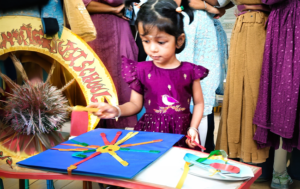

Learning happens best when children are engaged and immersed in play-based, interactive activities.
Storytelling is one of the most natural ways young children learn. When they listen to a story, they imagine, question, empathise, and remember. This is why storytelling in preschools is a powerful tool for early childhood development.
At Vikaasa, we use storytelling to nurture language, thinking, and emotional development, making learning joyful, meaningful, and age-appropriate.
What is Storytelling in Early Childhood Education?
When thinking about storytelling in preschool, you might imagine a group of students gathered around a teacher and listening to tales of adventure and animals.
But it’s more than just reading a storybook.
It refers to using stories, narratives, role-play, and visual prompts to introduce concepts and values. It’s an art of using voice, expression, pictures, puppets, or storytelling flashcards to share experiences, ideas, and emotions with young children.
For preschoolers, stories stimulate young minds, expand vocabulary, and strengthen their listening skills.
Why Storytelling Matters in PreSchools
- Language and Communication: Stories expose preschoolers to rich vocabulary, sentence patterns, and dialogue, helping them to learn how to describe, question, and express ideas clearly.
- Imagination and Creativity: Listening to and creating stories encourages children to visualise scenes, invent characters, and practise flexible, original thinking.
- Emotional Development: When children connect with the characters in the story, they understand different perspectives and feelings.
- Values and Decision-Making: Morals in stories teach children about right and wrong, consequences, and problem-solving in a safe, imaginary environment.
- Cognitive Skills: Following a storyline builds attention, working memory, sequencing, and comprehension, all of which support overall school readiness.
How Preschools in Madurai Use Storytelling in Learning
Story-based learning is an approach where teachers introduce stories that children can relate to and remember.
Many play schools in Madurai are moving from rote methods and using storytelling as a planned part of their curriculum.
Here are some of the ways Preschools use –
1. Storytelling During Circle Time
Teachers often begin the day with a theme with a story:
- Children sit in a circle while the teacher narrates with expressions, actions, and props.
- Teachers introduce new words, sounds, and ideas through stories, then revisit them through questions and short activities.
- After the story, children talk about their favourite characters or moments, strengthening recall and communication.
2. Play Story Building Games
Teachers and children can co-create stories by taking turns adding sentences about a shared character, often drawn from classroom events, which builds creativity and sequencing skills.
For example, a teacher might begin with a simple prompt, such as a boy who loves a kit or a cat who loses its hat and then invite each child to add one line. That encourages students to pay attention and improve their listening skills.
These activities build creativity, sequencing, and flexible thinking while keeping language learning spontaneous and fun.
3. Storytelling Days and Sharing Time
Many preschoolers schedule special storytelling days or regular sharing slots where each child narrates a story to peers.
Teachers usually prepare children in advance, sometimes helping them rehearse a favourite story at home or in a class. On the day, each child gets a turn to share a story with warm applause, and sometimes certificates are given to celebrate participation.
4. Puppets and Prop-based Storytelling
Many preschools use puppets and props that allow children to stay focused and emotionally involved in the story.
Teachers tell stories using hand puppets, finger puppets, dolls or simple objects like blocks and animals. As characters appear in the story, children move or point to them, helping them connect language to concrete objects.
Later, children are invited to “be the storyteller,” using the same puppets and props to retell familiar tales or invite new ones.
This approach helps to deepen imagination, fine motor skills, and social interaction, as children often collaborate and share roles during puppet-based storytelling.
| Activity | What it Develops |
| Storytelling During Circle Time | It develops listening, vocabulary, comprehension, and confidence in speaking and early communication skills. |
| Play Story Building Games | Creativity, sequencing, attention, listening skills, flexible thinking and spontaneous language use. |
| Storytelling Days | Confidence, public speaking, memory, narrative structure, and social-emotional skills. |
| Puppets and Prop-based Storytelling | Imagination, fine motor skills, turn-taking, collaboration, deeper engagement with language and social integration through shared storytelling roles. |
Conclusion
Storytelling is much more than just entertainment in preschool. Learning can be made interesting and meaningful by incorporating stories into lessons, play, and daily routines.
Preschoolers’ creativity, listening, cognitive, linguistic, social-emotional, and literacy skills are all enhanced by story-based learning. It enhances memory, expands vocabulary, and fosters empathy through storytelling games, puppets, props, character-based storytelling, and storytelling days.
At Vikaasa, one of the leading Play schools in Madurai, our early childhood programmes focus on play, symbolic exploration and learning spaces. It encourages curiosity and builds strong foundations for language, thinking, and emotional growth.
Learn more about our preschool admission at Vikaasa School.
FAQs
1. Why is storytelling important in preschools in Madurai?
It plays a crucial role in supporting children’s language development, listening skills, imagination, and emotional understanding.
2. Does storytelling help preschoolers improve communication skills?
Yes, storytelling helps to enhances childs vocabulary, sentence formation, pronunciation, and speaking confidence.
3. Can storytelling improve creativity in preschoolers?
When young kids hear stories, they draw, make things, or come up with their own endings. This helps spark their imagination and gets them thinking .
4. How does storytelling prepare preschoolers for primary school?
It builds strong listening, comprehension, vocabulary, and confidence, which are essential skills for formal learning and provide a smooth transition into primary grades.